Thank you for joining us again for another edition of The Brothers Brick’s nature documentary series, Planet Brick. Today we’ve spotted Joss Woodyard’s well-camouflaged Nettledrake. Made up of many LEGO pieces you’d traditionally think to use for plant life, this magnificent beast is naturally hidden. If you happen to come across one in the wild yourself, it’s best to observe from a distance and see it spread its wings and take flight. Don’t be drawn in by its pretty pink spots or tail. If you get too close, you might get stung by the vicious beast’s teeth or talons. Thanks for stopping by and discovering another beautiful creature inhabiting Planet Brick.
Category Archives: Models
Building a tiltrotor aircraft using Circuit Cubes [Review]
We’ve occasionally reviewed non-LEGO products on The Brothers Brick, by BrickArms, BrickForge or Citizen Brick for instance; companies that provide accessories for LEGO builds. A new kid on the block is Circuit Cubes. Instead of (accessories for) minifigures they make LEGO-compatible building sets and components, such as electric motors, aimed at teaching STEM subjects to children. They got in touch with me after reading my article on building a remote-controlled vehicle with LEGO Power Functions. They sent me several of their products in return for providing them with feedback. The sets themselves don’t interest me all that much. However, I would like to know how the Circuit Cubes components can be used to enhance my LEGO models. And this may interest those of you who want to motorize your own models too. So, this is not a traditional set review. Instead, I’m going to tell you about Circuit Cubes and how I used them in my own custom LEGO model: an XV-15 tiltrotor aircraft.
A tiltrotor is an unusual flying machine, but the basic idea is simple: with its rotors facing up it can take off and land like a helicopter; with them rotated facing forward they serve as propellers, with the aircraft’s wings providing lift. So, unlike a normal fixed-wing aircraft, a tiltrotor can land in tight spots or on small ships, but in forward flight, it is faster and more efficient than a helicopter. In practice getting this concept to work was difficult, but the Bell XV-15 TiltRotor Research Aircraft first flew in the late seventies and demonstrated that a practical and controllable tiltrotor was viable.
The challenge when building my RC vehicle was hiding the LEGO motors, battery box, Power Functions IR receiver, and what seemed like 2 meters of wiring. I could only fit them inside by building a van with quite a lot of space inside. Because of this experience, two of the Circuit Cubes immediately caught my attention: the Bluetooth Cube and the Cubit. The former is a rechargeable battery pack and Bluetooth controller in one. It has three outputs, remotely controlled via an app (available for Apple and Android). It is rechargeable using a USB cable. The Cubit is an electric motor. What makes these parts interesting is their small size. The Bluetooth Cube has a 4 x 4 stud top and is only two bricks tall. The Cubit has a 2 x 4 stud top and is also two bricks tall. This is much smaller than anything similar made by LEGO, with the exception of old 9V Micromotors.
Continue reading
From a sprig comes a delightful Bonsai Plum Tree
It’s not usually our thing to feature LEGO works in progress. But when ZiO Chao posted a sprig of plum blossom, we featured it. Who could blame us, really? The subject was expertly crafted and photographed with utmost care. The sprig alone was rather breathtaking, actually. So you can imagine our thrill to learn the sprig was a mere teaser for this entire Bonsai plum tree. The builder tells us that the plum blossom is one of the most beloved flowers in China and has been frequently depicted in Chinese art and poetry for centuries. They can bloom in the winter and have therefore come to symbolize perseverance and hope, as well as beauty and purity. In my opinion, the official Botanical Collection has been the best new idea LEGO has come up with in a while. They have been the inspiration for so many beautiful creations such as this.
The Star Wars Clone Wars unfold on a massive light-up Naboo diorama
Say what you will about the Star Wars prequels, Naboo is a planet that everyone agrees is beautiful. Inspired by its appearance in 2017’s Battlefront II videogame, Belgian LEGO Star Wars YouTuber Axidroid spent eight months building a Clone Wars battle scene in the streets of Theed. With 121 minifigures, with most of them being from the popular 501st Battlepack, there are also custom vehicles such as the Gunships, AAT tank, and AT-RT walker. While large Star Wars dioramas are not uncommon, the 140cm by 77cm size dwarfs the largest LEGO Star Wars set, the UCS Imperial Star Destroyer, which is 110cm by 66cm.
While the size of this build is impressive, the real kicker is at nighttime. Using Christmas LED lights inside the buildings and street lamps, Axidroid lights up the Theed plaza into a lovely atmospheric scene. The battle droids and clone troopers now look like they’re lined up for an evening festival, and bring the Mediterranean setting of Naboo even closer to home.
Axidroid even documented his 8-month long build process in a YouTube video series. In the finale below he shows off all the details in the expansive build.
Explore more builds of Naboo here.
But... will it blend?
Isn’t it funny that kids use LEGO bricks to build things that don’t exist in our world, but adult fans adore brick-built models of real-life objects? This pretties kitchen blender by Joffre Zheng has no ion engines, no laser guns, and does not breathe fire; still, it instantly captured my attention with its clean, neat look. And I know its secret! Did you notice the new corner bricks with bow 2×2? These are perfect for smooth transitions between vertical and horizontal surfaces. Although the bowl’s design may not be as perfect as the rest of the blender, I haven’t seen anything similar before. And now, here is the question… will it blend?!
A little light amidst a lot of dark
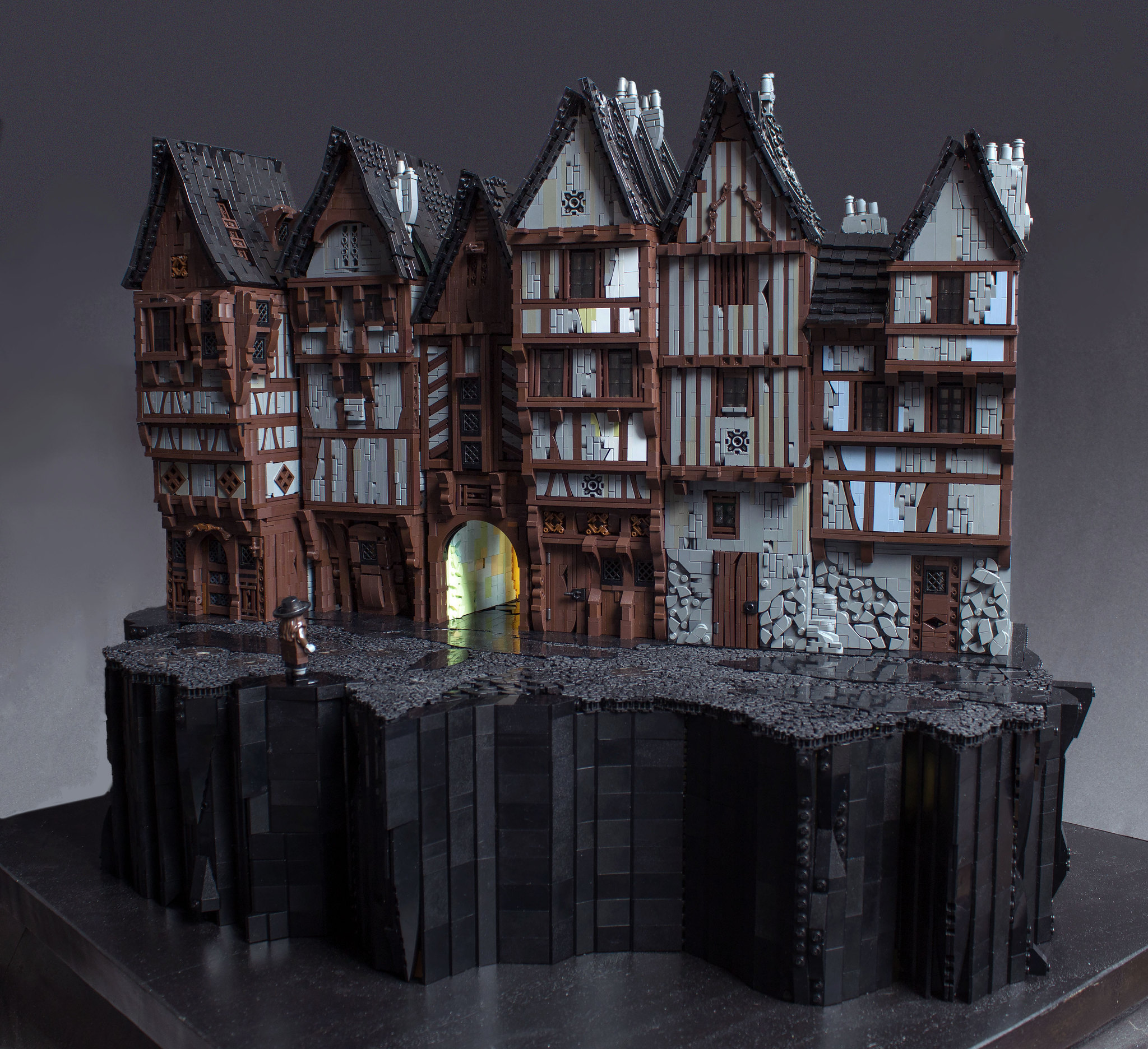
Is it a Tim Burton movie set? Is it a miniature fit for a museum about Medieval times? No, it is another fantastic creation from Ralf Langer. Ralf always surprises us with his super realistic medieval Tudor-style buildings. His creations are filled with tons of interesting techniques which he kindly reveals in tutorials not long after posting a creation. His latest model is called ‘A light in the dark’.
As far as I can tell Ralf didn’t use any special lighting to make the archway light up. He created the effect by using a range of yellow tones amidst a lot of grey, dark grey, dark brown, and black. The effect looks stunning. Another effect Ralf managed to get across beautifully is the calm after a storm. The streets look like they are covered in puddles. This is achieved by using chain link for the pavement. The puddles are made with black brick shapes which are placed between the chain links. The difference between the textured chain links and the smooth bricks really looks like rain puddles.
The T-70 X-wing of Poe Dameron’s dreams
There is always one LEGO creation where it’s “love at first sight.” You never expect that build to leave you breathless, but when it does, it does. This UCS-scale T-70 X-wing by Jared Reisweber is the one that stole my heart. Instantly recognisable from Star Wars: The Force Awakens, this massive model is the most accurate representation of Poe Dameron’s starfighter that I’ve seen so far. It helps that this build is larger than it appears, capturing even the tiniest, most intricate details, and replicating the complex shapes and curves, which even the best of builders struggle to get accurate. Sometimes all it takes to build the perfect X-wing is to go big or go home.
Click here to get a closer look at the starfighter…
Waia Konekta
Joss Woodyard shows us that he is not afraid of using color in his LEGO creations. His creation titled Waia Konekta is very vibrant and lovely. There are a few parts in this creation that are used very creatively. The wire connector is used to create a grass necklace of the Waia Konekta. Next to that the wing with feathers gets used quite a lot in a range of different colors. It is used in the grass skirt and in an elaborate headdress. The use of the 12 tooth gear for teeth is quite ingenious, and there is just something about those eyes. They appear to follow you, and it looks like the Waia Konekta can see straight through you. Did I mention this creation reminds me of the mask in Crash Bandicoot?
Cable Clip Chameleon
Builder Joss Woodyard has made a chameleon out of LEGO and it’s simply a small work of art. There are a lot of axle connectors used in this build for the tail and the spine of the creature. I love that it manages to stay true to the color scheme of an actual chameleon. White wedge plate create gaps that resemble the mouth and there is great part use with the pumpkin part used to portray the characteristic eyes which bulge out the side of their head and appear to swivel about in all directions.
Parfait por favor
Nobu Tary makes us long for summer with their latest LEGO creation. This built doesn’t use a lot of pieces and it is actually fairly small. The main piece in this creation, which is used beautifully, is the Ninjago tornado spiral. Which works perfectly as an ice cream coupe glass. The white swirl towards the bottom looks like slowly melting ice cream dripping towards the bottom of the glass. The classic baguette piece gets used as a ice cream wafer stick which to me is just brilliant.
Ten years of Ninjago in a single build
How’s this for dedication? Lee Chi Wing (city son) binge-watched all 14 seasons (160 episodes) of Ninjago to make sure the stories and characters were represented correctly in this amazing tribute. The build itself was accomplished in just seven days, too. Take a little time and treat yourself to a close look at this masterpiece.
Who can you spot? Can you name everyone? Identify the seasons? Want some hints? Lee Chi Wing has you covered with a host of images as an answer key!
Continue reading
From animation to automata [Video]
In 1878, Eadweard Muybridge studied animal locomotion and took a series of pictures of a trotting horse to see every phase in a stride. How? He placed 24 cameras around a racetrack, each 27 inches apart. As the horse trotted past, a tripwire each shutter was snapped. Combined, those pictures became a precursor to motion pictures, and technically, the first GIF. In honor of this, Tobias Munzert has built a mechanical LEGO version that gallops in stride with the original animation.
The mechanics are timed really well to get that genuine look of a horse in motion. If you look closely, you can see that even the head pushes forward slightly. You should also take a closer look at the excellent parts usage on the neck, head, and feet!
While you’re here, check out some more cool horse builds, and other mechanical models.