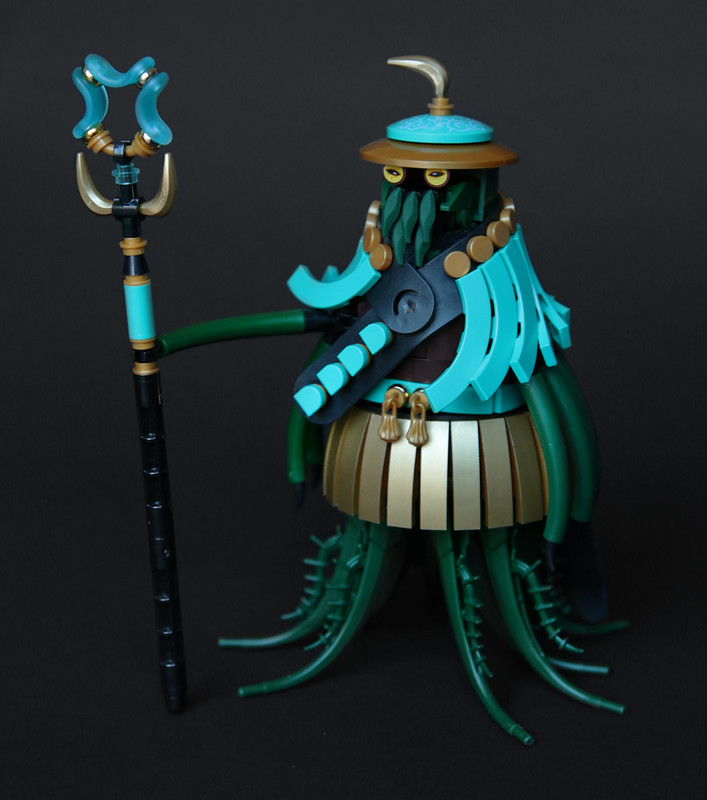
LEGO revealed their DOTS line and some folks reasoned it would be great for their little sisters but not for the likes of them. Vince Toulouse illustrates the error of their ways with this Ambassador of Grnx wearing a DOTS band as a sash. His staff makes use of Clickits connectors, another line some of youse thought was only appropriate for little sis. As if that wasn’t enough, Vince brings in another limited appeal line with the use of flame bits from the short-lived Ben 10 sets. It just goes to show that on the surface, some sets have limited appeal but in the hands of a builder like Vince, there is no limit to what can be used.
Category Archives: Models
The tower of Barad-d’aww
How small can the dark lord get? This teeny, tiny tower of Barad-dûr from The Lord of the Rings was constructed by LEGO builder Hubba Blöoba, and it’s got all the right notes despite its diminutive size. A pair of grey bananas make the two spikes that ring the all-seeing eye, while clips and slopes make up the jagged tower itself. The atmospheric clouds elevate this little vignette further and give it an appropriate sense of foreboding.
From the Star Wars expanded universe comes the Outrider
We all love the Millennium Falcon and other ships from the Star Wars franchise but it’s neat when someone pays attention to the ships that were later inserted into the background in one special edition or another. My case in point, this LEGO YT-2400 Outrider built by Aido Kessler. It resembles the Millennium Falcon a bit in the sense that it’s saucer-shaped, has circular exhaust ports and pushes the whole asymmetrical cockpit motif to the Nth degree. From there this odd ship exudes its own personality. I love the complex curves along the leading edge as well as the turret cannon. Aido tells us this model comprises of more than four-thousand pieces and weighs eleven pounds (5kg). In some instances this heavy creation was pushed to a breaking point; a literal breaking point and needed to be restructured several times.
The end result is breathtaking and we’re glad he was up for the difficult task. This rear view showcases some added light functions that makes this model truly a sight to behold.
477 mini plastic parts to make the iconic Mini Cooper
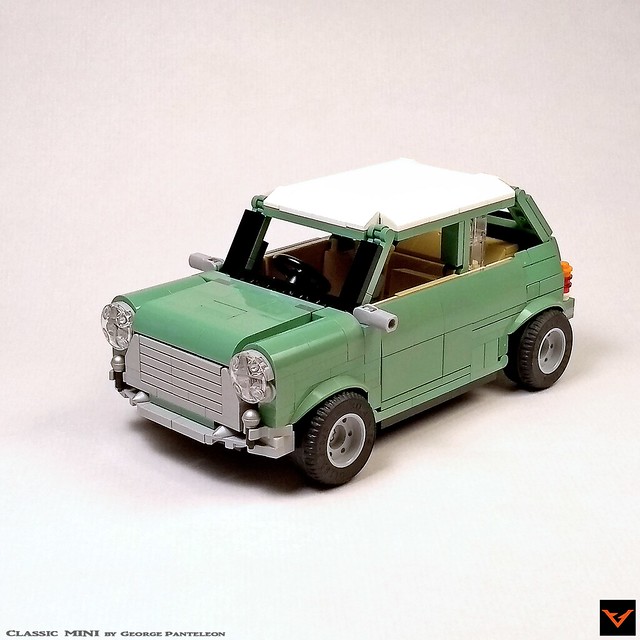
George Panteleon brings us a car we’ve seen before. It’s the classic Mini. LEGO released the mini cooper set a couple of years ago. George’s rendition may or may not be a different version of the mini car. I couldn’t tell you because I am no expert when it comes to cars. I do know that I really like his rendition of the mini. LEGO released 4 sand colors (red, purple, green and blue) and then decided to not use them all that often. George proves that that is a shame by using sand green to make this lovely build. There are a lot of nice little details on this build. The car grill is made of the back side of the masonry bricks, the microphone utensil gets turned into direction indicator lights and the bar holder with handle gets turned into a side way mirror. Best thing about this has to be that you can actually open the doors and even pop the hood. I say job well done!
Big Ninjago style in a little model
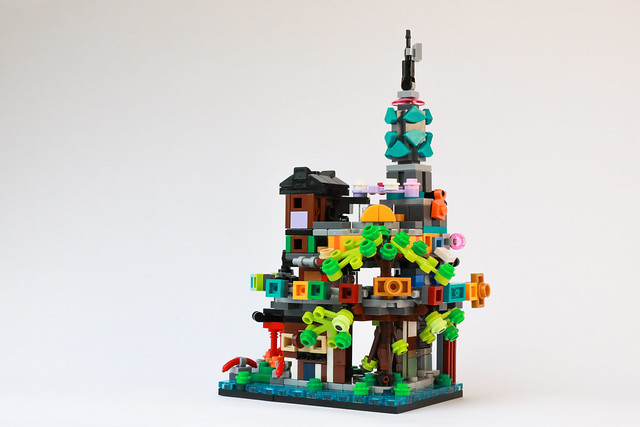
The Ninjago City modular sets are large, there’s no doubt about it. In fact, the latest set in the series, Ninjago City Gardens is one of the 10 largest LEGO sets ever released. When you line up the three sets together they take up quite a lot of space. Well, that’s not an issue with Adeel Zubair, who has built the latest city block in amazingly accurate details.
The inverted brown flower stem makes great tree roots, and the hot dog makes a perfect bridge. One more detail that I love, is the teal corner tiles used for those fancy sloped parts used in the control tower.
But the fun doesn’t stop there. Adeel has shrunk the entire series of Ninjago City blocks.
Castro Theatre, the heart of Eureka Valley
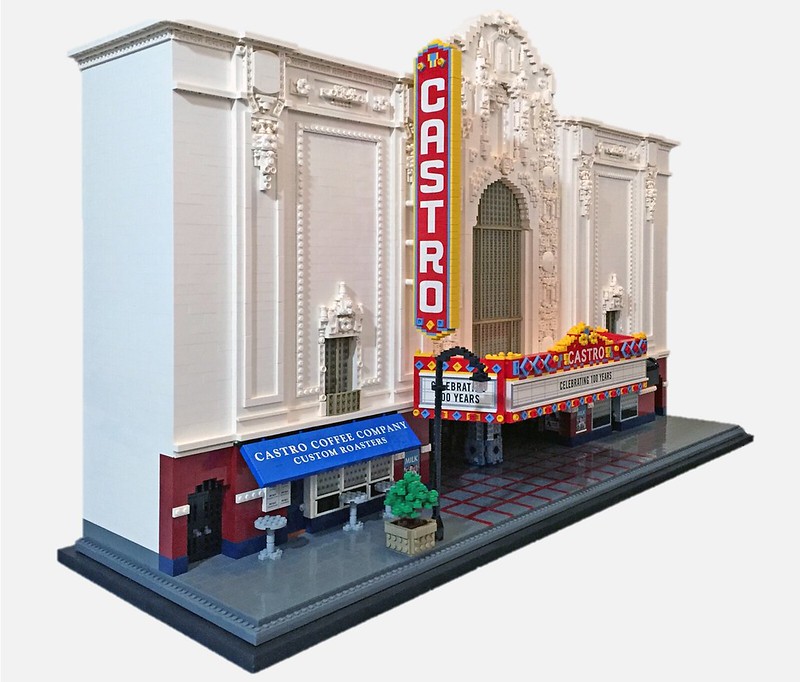
One of my favorite things about San Francisco is its architecture. Though shops have closed and the streets are nearly empty, some of the city’s most vibrant buildings still stand. Just off Market Street, you’ll find the Castro Theatre, whose majesty has been translated into LEGO by Jonathan Lopes. Since 1922, the Castro Theatre has hosted everything from queer cinema to silent film festivals at the center of San Francisco’s vibrant arts scene and historic LGBTQ+ district. Like in Jonathan’s model, you can’t miss its iconic neon signage and stunning Spanish-Baroque facade.
Click here for an in-depth look at the Castro Theatre!
Tiny cars are big in Japan
Over the years Japanese car manufacturers have produced some iconic performance cars, such as the Impreza WRX, the Datsun 240Z or the Toyota AE86. However, unsurprisingly, most of their products are of a rather more practical nature. Few more so than so-called Kei cars or keijidōsha (軽自動車). This literally means light automobile.
They are a special class of tiny cars, restricted to a width of 1.48 m, a length of 3.4 m and a height of 2 m (4.9 ft, 11.2 ft and 6.6 ft, respectively). Their engine displacement is at most 660 cc (40 cubic inches). For comparison, this is roughly the same as the displacement of a single cylinder of, say, a V8 Ford Mustang. So, why would you want one? Well, they’re relatively cheap to buy and run and owners pay less road tax. And more importantly, in densely populates cities such as Tokyo, owners need to prove that have a parking space before they can register a car, but Kei cars are exempt. Consequently, about one in every three cars sold in Japan is a Kei car. They are exercises in maximising interior space within limited external dimensions. So they do tend to be small boxes on wheels. However, as these two examples show, some manufacturers do spend some effort on the styling.
The Daihatsu Move Canbus is aimed at a very particular demographic: single women in their thirties. Fewer Japanese people are getting married and apparently this is a sizeable group. In Japan, unmarried women also often still live with their parents, so the car should be practical (with good access, through its sliding doors) and yet cute. The Honda N-Box Slash represents the edgier corner of the Kei-car universe. It’s very boxy, seats four people and has a dinky engine, but its styling is a little bit sportier, with an up-swept beltline near the rear windows and the handles for the rear doors hidden in the C-pillar. I hesitate to think what the marketeers were thinking when they came up with the names, though. I guess English names sound cool to Japanese customers, even if they make little sense.
There’s a house on my street, and it looks real neat
There are times when a LEGO fan starts building, gets into the groove of things, then finds it hard to stop. Especially when the build is a small street that keeps growing with each mini modular building placed on it. When I (Mansur “Waffles” Soeleman) attended my LUG‘s (LondonAFOLs) monthly meet-up via Zoom, the theme was mini modular buildings. Every year since 2007, LEGO released a large modular building, each of which can be arranged into a street layout. As a fifth anniversary to the lineup, LEGO created a microscale version of the first few buildings. I started to build a micro modular for the meet-up, and then I couldn’t help but build more. A few days after the meet-up, I ended up with a whole street.
Click to see each micro modular building in detail, along with the build process!
Today’s tiny houses, LEGO edition
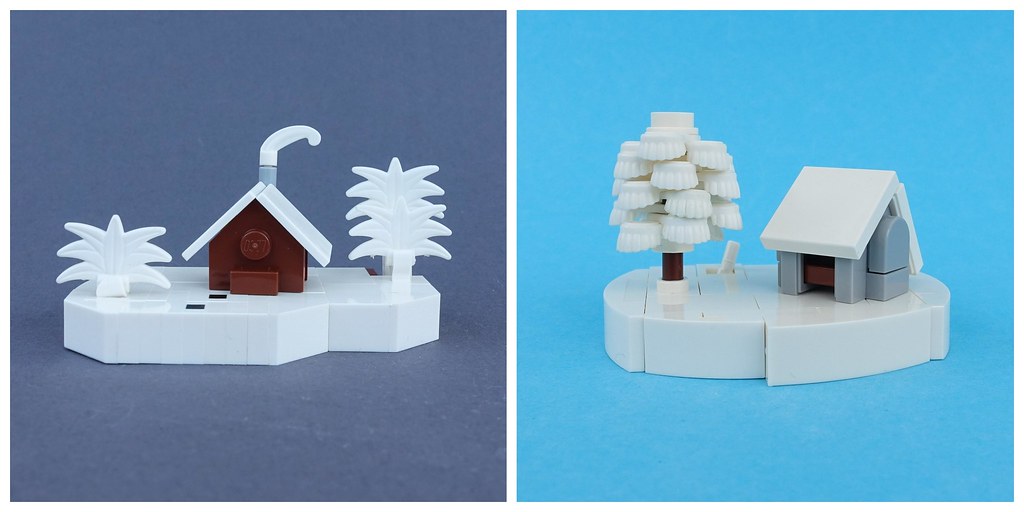
I’ve always admired the tiny-house movement and its adherents; it’s always wonderful seeing these little homes while out on a drive. Therefore, unsurprisingly I am also delighted to see minimal LEGO houses often done as mini-builds or in microscale. Patrick’s tiny LEGO house certainly takes LEGO minimalism to the next scale!
In order to execute this build, Patrick uses a combination of vintage and new elements as well as a mix of unique and common pieces. The snowy ground the house rests on is comprised of a few white 1×1 bricks, slopes, and plates arranged by way of the SNOT (studs not on top) technique. The body of the home mainly makes use of the 2×2 pentagonal plate – a very interesting and not so common piece. Two types of feather pieces are utilized here – the single feather which renders smoke coming from the chimney and the plume feathered headdress which Patrick uses as snow-covered trees. In another build featured below, similar use of old and new, common and unique, is also used.
An esteemed member of Discworld’s Unseen University faculty
When it comes to the Discworld universe, I know very little. But when it comes to recognizing clever parts usage on a rad LEGO creation, I’m all over it. Eero Okkonen’s recent tribute to the “Senior Wrangler” instantly reminded me of a similar build we covered a while back. At that time, it was the Archchancellor of the Unseen University, Mustrum Ridcully. What I love most about this chubby fellow is his excellent beard. What better alternative use for a white shin-guard than a beard? I also admire the use of chrome exhaust pipe elements on his jacket/rope.
Builds like this are Eero’s specialty. While you’re here, take a look at all of the magnificent characters we’ve featured!
It’s a cat-love-dog world?
In our current apocalyptical-like times, I’m sure most of us could use some feel-good imagery or stories in our lives. Here’s a sweet little LEGO vignette by Sebastian Arts, involving an amicable relationship between natural enemies – a cat and dog.
The main portion of the build is a fractured architectural setting with a post-apocalyptical feel to it. The drab grey color-scheme is made interesting by the sharp forms Sebastian shapes using mostly plates, slopes, tiles, and even blades. Some rounder elements are also incorporated, including 1×1 cylinders, 2×2 ridged cylinders, 1×1 cones, rounded sticks, and my favorite piece here – the technic bearing plate which is utilized in multiples to create a small roof. The focal point of the model is definitely the red 3×3 heart plate with a red 2×2 circular tile suspended over the orange striped cat and grey and white husky dog, all of which add a splash of color within the monochrome built environment. What can I say? This model just warms the heart but is also aesthetically quite pleasing.
Keep hitting snooze, you lose.
It’s been a while since I’ve seen an actual digital alarm clock, to me they actually even seem old-fashioned – don’t most people just use their mobile phone? But the physical alarm clock and your iPhone timer have one thing in common – you can hit snooze. Ted Andes gives us a LEGO model of the standard alarm clock with its digital face displaying 11:00, I guess someone hit the snooze button one too many times!
The body of the clock is simply fashioned out of a collection of black bricks, tiles, and plates. There are a couple dials on the right which utilize some rounder elements. Andes uses red minifigure torsos with the arms removed in red to create the display’s numbers – a pretty unorthodox use of parts. The colon between the hours and minutes are some cylinders also in a nice bright red color. While the build is simple, there is still some nice parts usage utilized in the work and the concept is timeless.