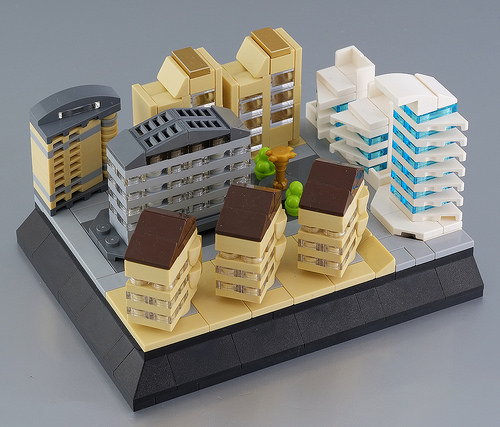
What I particularly love about building in microscale is that it makes you value every single piece and every spare stud of space. When a tiny 1×2 slope becomes a very huge section of the building’s roof you become very careful with planning your creation. And Marco De Bon‘s tiny quarter is a brilliant example of careful planning and very nice execution. Despite a very limited variety of pieces and colors, this neighbourhood looks both elegant and surprisingly diverse. My favourite part would be those small balconies of the white apartment building; the use ofplate 2 x 4 wedge‘s shape is just stunning.
Tag Archives: Microscale
Head into space battles aboard the Andromeda
Large spaceships are a flagship of LEGO space creations, where “large” is generally accepted to be 100 studs in length (or honestly any other spatial dimension) — these are called capital ships or SHIPs (Super Huge Investment in Parts). For the past few years, it’s seemed like there might be fewer built throughout the year, because many people rather concentrate their efforts in the annual SHIPtember community challenge in September. So in a way, Lysander Chau‘s Battleship Andromeda is like a Christmas gift in May, and I hope your big spaceship lust is as satisfied as mine.
Click to see more of the Andromeda
Micropolis block packs a lot of Microscale punch
The Micropolis standard is what allows LEGO builders from around the world to come together at a convention and build a sprawling but tiny city that fits together. Here, LEGO creator Tammo S demonstrates some great microscale building techniques in this city block, featuring a hotel, some apartments, a pizzeria, a few residential buildings and a lovely courtyard. The model has a very European vibe, with a variety of dormer window designs, satellite dishes, and landscaping.
See more photos of this lovely little town
Build your own microscale LEGO Star Wars Republic Gunship, complete with decals [Instructions]
I was never satisfied with LEGO’s attempt at a microscale Republic Gunship (also known as an LAAT) from the 2013 advent calendar, as it lacked the signature long engines, unless that’s what the binocular piece is supposed to represent. So a few days ago, since I’m working on a larger Star Wars microscale build, I thought I would try my hand at a micro LAAT, then a day later, I ended up with these two. Although I wasn’t worried about part count, these use only 19 pieces each, just five more than LEGO’s version.
Check out the video instructions below — there are picture versions, and a video that goes a bit more in depth on how to build this cute little model. I have also included a link to download the decal sheet I made, so you can print it out yourself as well.
Click here to see the instructions!
We’re mesmerized watching Luke dodge Vader in this Death Star trench run kinetic sculpture [Video]
We recently featured a World War I dogfight kinetic sculpture by Jason from JK Brickworks. In his video, Jason promised to share variations on the theme, and he’s done so with this fantastic trench run scene from A New Hope. The little starfighters and greebly Death Star surface are excellent in their own right, but the movement takes this LEGO creation to the next level.
The video shows Luke’s X-wing evading Darth Vader’s TIE fighter, with turbolaser turrets swinging back and forth as well. Jason also takes the kinetic sculpture apart to explain how he added the extra motion for the turbolaser emplacements.
Space trucking across the universe
The arrival of the tiny Classic LEGO Space microfigure in the recent 5005358 Minifigure Factory set was bound to prompt a batch of teeny-tiny space creations. Andreas Lenander‘s microscale space truck is exactly the sort of thing I was hoping to see — impressively detailed and greeble-covered for the scale, spot-on in its colour scheme, and super-cute to boot. The rocky “tan-scaping” around the build creates a nice alien landscape feel (and the figures are well positioned to conceal those unsightly bases behind the boulders). And is there a little hint of Optimus Prime in the truck’s “face”? I think there is, and it makes me like this even more.
Sleek LEGO ship is a star of a destroyer
Sleek and grey and deadly — a predator slips through the swell. At least that’s the image conjured up by Luis Peña‘s latest LEGO creation — a microscale model of a Porter-class US Navy destroyer. Although small in scale and simple in colour selection, this model manages to pack in some nice details and textures. I particularly like the use of “Wolverine claws” and quarter-circle tiles in the creation of the ship’s anti-aircraft emplacements.
The Porter was a class of eight heavy destroyers in the United States Navy. Although originally commissioned by Congress in 1916, construction was delayed and the first of the vessels didn’t enter service until 1936. The destroyers went on to see action throughout the Second World War. Only one, USS Porter herself, was to be lost in action.
Small Temple of Airjitsu is big on charm
There has been a recent wave of microscale models inspired by official LEGO sets… Maybe Brainiac has set his intergalactic collector sights on LEGO creations. This microscale model of 70751 Temple of Airjitsu by play captures many of the great details of the larger set perfectly, from the tree next to the blue blacksmith shop to the gold ornaments on Sensei Wu’s tea shop. The temple itself is the perfect miniature replica of the traditional structure.
A Miniature Mediterranean Masterpiece
One of the joys of building in microscale is the challenge of doing more with less. In “The Bull Girls,” flickr user Letranger Absurde has proven adept in the art of micro-building. The entire scene has a Mediterranean flair to it. In particular, the microfigure with the red dress reminds me of a Spanish flamenco dancer. You can even find a piece of a flamenco dancer in the thatched-roof building…literally! The curtain over the entrance is actually the dress from the Series 6 collectible minifigures flamenco dancer.
It’s amazing what one specific part can do bring a little LEGO creation to life, and this model is packed full of fun details. The use of the black wizard beard for hair is brilliant, and I’m a big fan of the roller skates & cupcake holders that make up the microfigures’ dresses. The curved tree trunk also adds a lot of character.
My favorite part is the bull, which uses brown frogs for legs, minifig arm for a tail, “gorilla fist” for a head, and white cattle horns that first appeared in the 1994 Pirates Islanders theme. It’s a truly inspired design!
Infinitely small LEGO Avengers
Massive new Marvel movie coming out? What better way to celebrate than with a set of teeny-tiny LEGO Avengers? I couldn’t resist giving these guys a go in micro/nanoscale. There’s not that many characters you can reduce to this scale and still keep them immediately recognisable, but the distinctive colour schemes of comic book superheroes make it possible. The model is not quite purist — there was a little bit of cutting involved (HERESY!), and two sections are balanced on each other rather than stuck together. But I think it looks cool so I’m begging forgiveness. (Bonus points for any eagle-eyed commenters out there who can spot which piece I cut…)
Micro Taj Mahal fits in the palm of your hand.
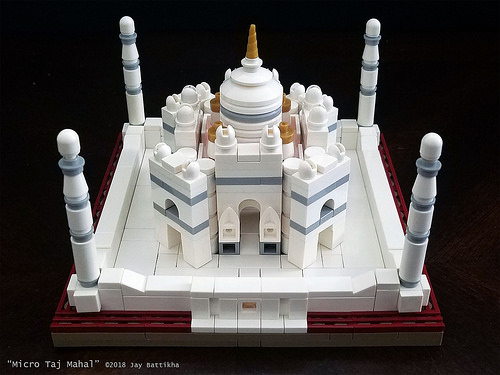
Building a microsocale landmark is a fine art of choosing the right miniature detail that makes your model instantly recognizable. Some landmarks are so iconic that it might seem like this would be too easy. Not so! Finding the perfect detail part can be challenging. In this model of the Taj Mahal by Jay B, several recently introduced parts provide great details, but might not be the first thing that a builder would think of.
This model reminds me of one of the very first models that I posted on Flickr over 5 years ago, using a much more limited supply of parts.
Interview with Jeff Friesen of Cityscapes, The Brothers Brick’s Creation of the Year 2017 [Feature]
We singled out Jeff Friesen’s Cityscapes as our 2017 Creation of the Year. If you’ve missed it then, these are still very much worth a look, and even if you’ve seen them, they’re so mesmerising that you may find something you missed earlier on. It’s almost soothing and appealing to let your eyes wander around these intricate builds.
We could not resist reaching out to have a deeper discussion with Jeff to understand the mind of an artist that could create something so different and unique with the very same bricks all of us see and build with every day.

Can you tell us a little bit about yourself, e.g. where are you based, your LEGO history, and your work (LEGO/Photography and real life if it is different)?
I’m an award-winning photographer based in Victoria, British Columbia, Canada, which is on Vancouver Island. I have vivid memories of playing with LEGO from the age of 3 (that was in the early 1970s). I had a shoebox full of white and red bricks in the classic sizes, mostly 2 x 4s. Those bricks were used to make everything from aeroplanes to cities to double-decker car ferries for Matchbox racers. Recently, I was wondering why the brick selection was only red and white. After doing some research it appears the bricks must have been a hand-me-down set from the 1960s. Back then LEGO used to have basic building sets in just red and white.
The late 1970s brought with it the dual treasures of minifigures and Space LEGO. I essentially lived in a Space LEGO drama for a few years. Blue, trans-yellow, and grey were the primary colours of that era. As a child, the actual LEGO building is just the beginning of the fun, and then you get to play with what you’ve made. As an adult, I’ve replaced the play phase with photography.
It’s amazing how LEGO has been there through every stage of life, and now my daughter’s life.
Click here to continue reading our interview with Jeff Friesen