The Brothers Brick regular Andreas Lenander has built a LEGO Ma.K SAFS Raketenwerfer, which I’m pretty sure is German for “launching rockets in a field of olive cheese wedges”. Don’t quote me on that. But that’s pretty much what is going on here. It’s just a small part of what is in store from Andreas in October. I’ll keep an eye out for what this builder is up to and I advise you do the same. This will get you started.
Tag Archives: Andreas Lenander
It’s come full-circle
Andreas Leander has us reeling at the sight of this mesmerizing SHIPtember build. Though its perfection might deceive you, the STS Serpent is not a render! This stunning LEGO exploration vessel measures to around 110-120 studs long, including its rear engine and cannons. The secret to its cookie-cutter form– a skeleton of curved train tracks hidden under layers of slope bricks and tile pieces. Andreas does a wonderful job of balancing smooth and greeble, opting for a textured “underbelly” in contrast to a smooth, studless exterior. The cannons on its side are a fantastic addition, really, the chef’s kiss on top of it all. It’s truly a vessel fit for any space expedition!
Lovin’ this SHIP? You can check out other builds by Andreas by clicking here.
Operation space-goat teleportation
Space is the place for ground-breaking science like figuring out how to teleport rare pieces of your LEGO collection from one place to another. Andreas Leander is here conducting the research in his latest diorama. It follows the everyday lives of Sven and his crew at Epsilon IV as a part of Andreas’ ongoing series of cinematic Classic Space builds. This time, the crew is trying out a new contraption to teleport a space-goat, but rest assured, none have been harmed in the process.
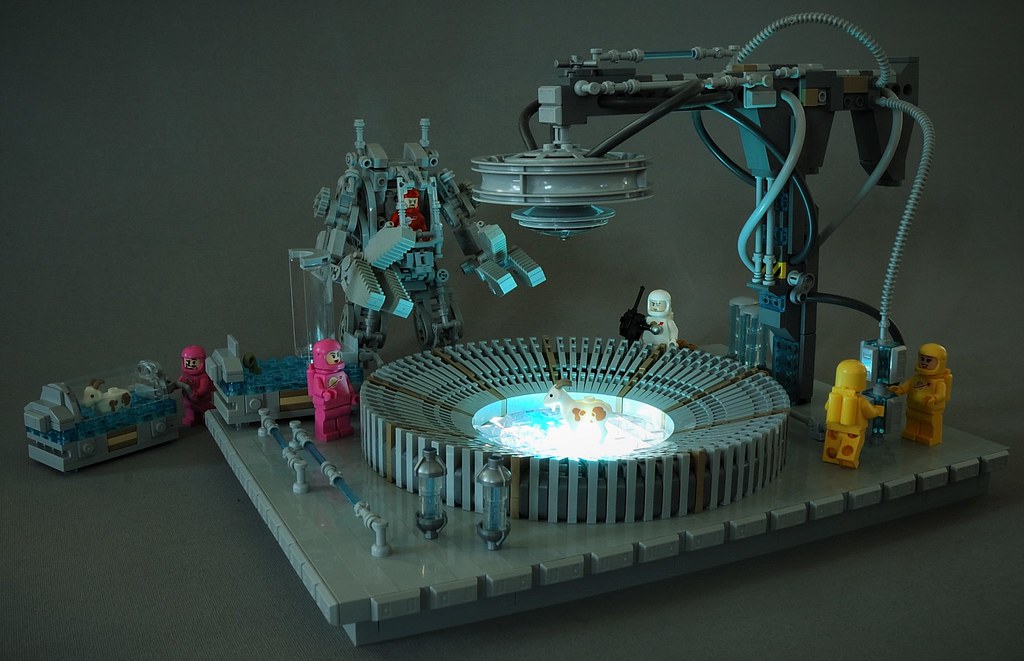
The teleportation device is made with a variety of tubes running along a simple frame. The tubes feed into a stack of different-sized radars and a Harley Davidson wheel that hovers ominously over the test subject. Alternating long wedge plates and 1×2 rounded plates surround a single space-goat, totally oblivious of what’s to come. The platform construction is super captivating to look at and the blue lighting at its center creates a gorgeous atmospheric glow throughout the build. I’m also loving the details scattered around the scene. An old mech makes an appearance in the background, which we assume is used for transporting the space-goat from pod to platform. If you look even closer, you might see that the pods each have a single plant piece for the space-goats to munch on as they wait for their turn. All this talk of space-goat teleportation has many of us wondering when these space-goats will start arriving into our LEGO rooms. We can’t guarantee any goats, but do keep an eye out!
In the meantime, check out some more Neo-Classic Space creations from our archives!
A desert dwelling worth gold ingots
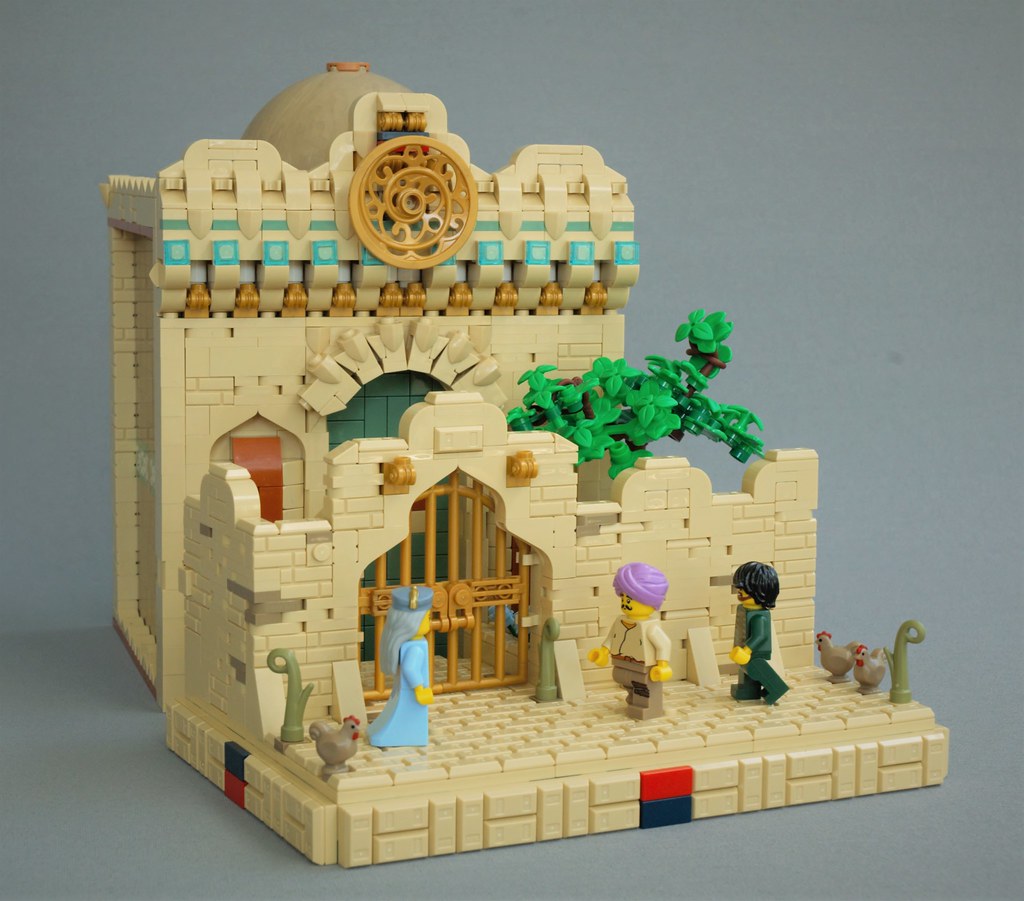
As any builder knows, the release of an existing LEGO piece in a new colour provides lots of opportunities for building. Such was Andreas Lenander‘s thinking when getting hold of the gold ingot in tan, a new colour for the piece. His build of the aptly named Kumi’dia residence utilises this part all over the middle-eastern style dwelling. The ground is packed with these ingots to represent cobblestone brickwork as well as the textured base of the build. But my favourite is their combination with masonry bricks and 1×2 rounded plates for the textured wall. With a sprinkle of dark tan here and there, it perfectly conveys the weathered wall of the desert retreat.
Some gold and transparent light blue parts adorn the top of the building, conveying the resident’s wealth. In addition, Andreas uses a Bespin hemisphere part (from the Star Wars: Planet series) for the dome. Aside from the building itself I really like the small tree in the courtyard. It uses lasso and whip parts connect the leaves, which is a unique building technique and difficult to get right.
See more of Andreas Lenander’s builds here on TBB, as well on his Flickr, where he has similar architectural builds.
LEGO brick shows its true colors
No matter what color we are on the outside, inside, we are all the same. If you crack us open, we spill our bright and beautiful ABS plastic filling out into endless possibilities of shapes and forms. Andreas Lenander reminds us that many beautiful and amazing things can be created from LEGO elements, which have certainly come a long way since that first 2×4 classic red brick.
A welcome shelter from the cold
If you are traveling across the land in winter, a place to shelter for the night and get out of the cold can be a true treasure. In this scene by Andreas Lenander, a humble stone tower provides a place for weary travelers to escape the harsh temper of winter. The use of stacked mason bricks at the corners provides subtle texture, along with the simple choice of a few green plates. I also love the river breaking out of the base, with some transparent plates to give the brook a babbling appearance.
Chubby Grimlock is the best Grimlock
So…anyone else finding that self-isolation has lead to needing to let a notch or two out on your belt? It can’t be just me, as this LEGO Grimlock by Andreas Lenander seems to have put on a few ounces as well. Personally, this cute and cuddly version of the leader of the Dinobots feels like an upgrade. I like the highly-articulated tail, the use of ingots to break up the the curved slopes, and those cute little arms.
At least he’s venturing outside, based on those flowers. I should probably do that, too.
Minifig springs from the original LEGO brick
In the beginning, there was Brick, and it was good. It was smooth, perfect, and devoid of all color. Then one day, a great rumbling was heard deep within the brick and a wonderous sloshing sound. With a mighty crack, golden yellow life burst forth from the brick and spilled color into the universe. So goes the legend of the first Minifig, captured in all its glory by Andreas Lenander
A tiny escape from the world
Are you looking for an escape from the day to day grind, but have only a modest LEGO budget? Maybe you can take inspiration from the Teeny tiny treehouse built by Andreas Lenander. It’s just as sweet as a large Ideas set, but at a fraction of the part count. Andreas hasn’t shared any instructions, but we can still make some guesses as to what supplies you’d want. First, you’ll want to snag a decent amount of minifigure lassos, as they form the basis of the tree. You’ll also need some cheese slopes, headlight bricks, modified 1×1 with rod plates and rounded 2×2 plates for the ladder and treehouse. Oh. And some various bits of greenery. I’m sure it’s a super easy build. I’m also sure that the last statement was a complete lie. This is some skilled and imaginative craftsmanship.
Still, if we all give it a go, we could be on the verge of a giant (albeit microscale) treehouse boom. Think of how relaxing that could be!
The portal drew him onward
Out for a walk in the forest, and you stumble across an ancient inter-dimensional portal. What to do, what to do? Only one thing for it — grab your gear and see where it takes you. Andreas Lenander‘s LEGO portal gate is nicely weathered, creating a sense of age and decay, and the tree is wonderfully gnarly and twisted — a result of it being constructed mostly from minifigure lasso pieces. However, the eyes are drawn inexorably to the glowing blue portal, a collection of around 600 stacked lightsaber blades, backlit to create a stunning effect. It looks great, but I dread to think what happens when Andreas tries to move this thing!
Whatever floats your goat
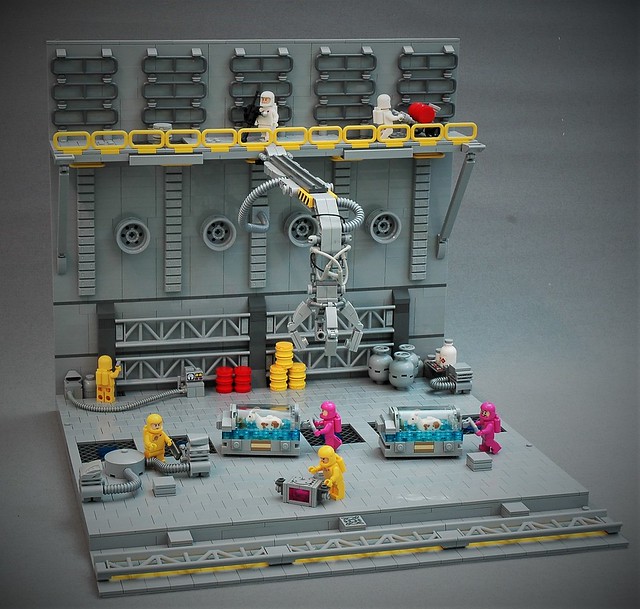
If you’re like me, you’ve probably lost plenty of sleep wondering if there will be goats in outer space. Thankfully, Andreas Lenander has built a LEGO diorama that ought to squelch our nocturnal worries. It’s a rather neat Goat Transport Facility on Epsilon IV that uses robots and other science-y stuff to make sure the future and outer space still have these lovable and occasionally delicious creatures around to chew your socks or whatever. Amazing details abound whether they be the repetitive use of ingots, well placed tire rims or flex-hoses. My favorite part would have to be the adorable goats in their own floating hermetically-sealed containers. You can say the containers are…totes-ma-goats. Tee hee. Hah! Am I right, people? Hilarious, right? No? OK, I’ll just let myself out. Sorry.
The cutest of sea cows
Did you know that some people hypothesize the name “walrus” originated from the Danish word “hvalros” meaning sea horse or cow? So naturally, walruses and Denmark-based LEGO would go hand in hand! (Or flipper in brick, I suppose.) And this lovely brick-built pinniped created by Andreas Lenander is as adorable as they come. Look at those little tusks!
Speaking of tusks, part of their scientific name, Odobenus, means “tooth-walker” and refers to how they drag themselves out of the water by those giant canines. So now you know! If you would like to check out more animal builds, take a look at this lifesize-(ish) rat, an elegant buck, or a fishing grizzly bear. We’ve even featured the walrus’s vulnerable neighbor, the polar bear.