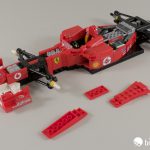
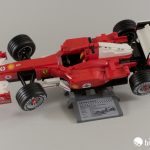
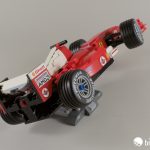
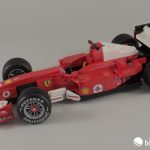
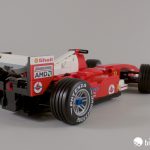
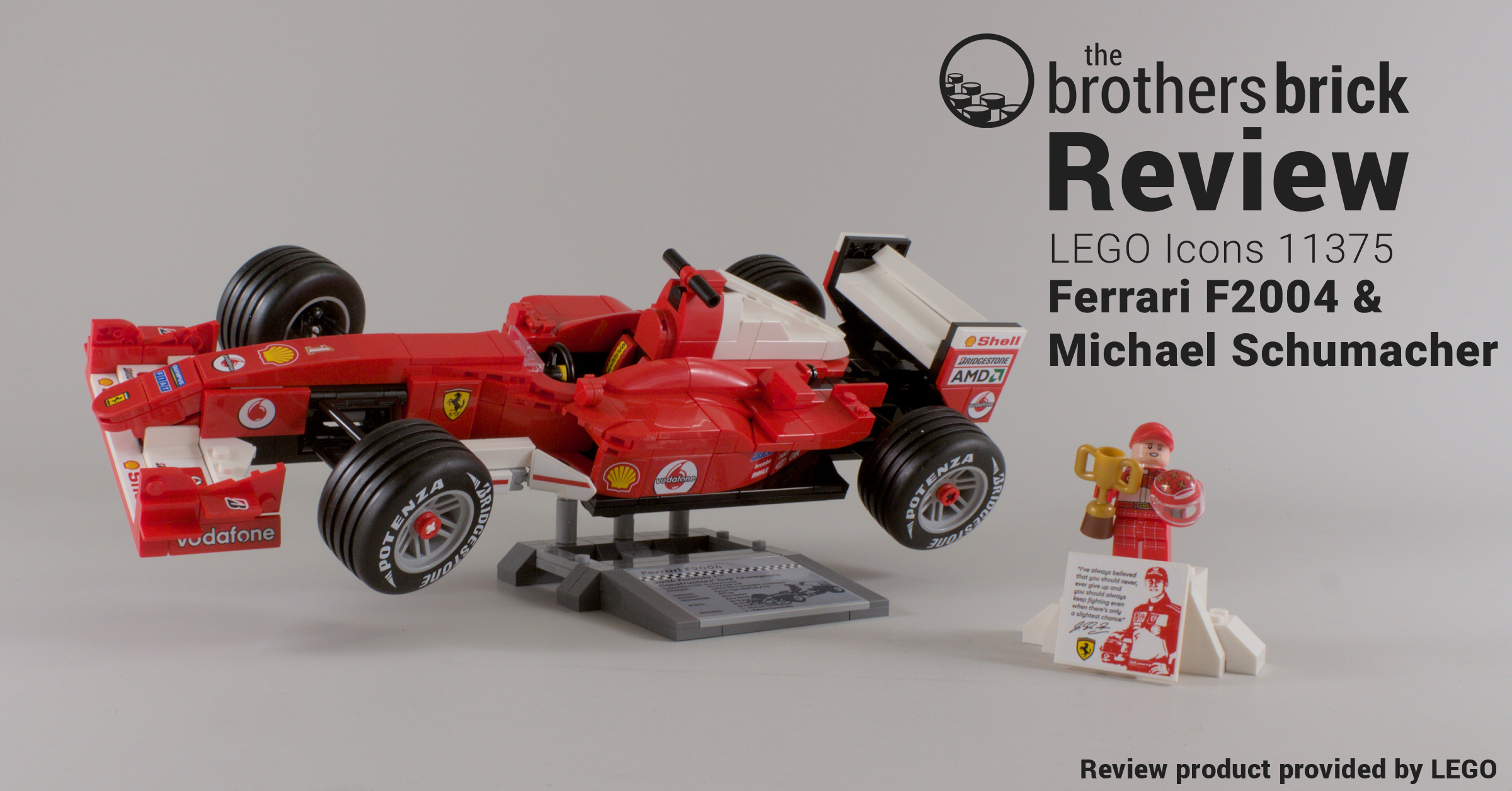
Reading patterns into LEGO’s release schedule is normally a fool’s errand. The minute you think you can guess what set is coming next based on what’s been before, the pattern changes. That said, after previous years saw releases of the McLaren MP4/4 and Williams FW14B – two of the most famous Formula One cars ever – the next car in this fledgling series should be a surprise to no one. The Ferrari F2004 dominated the, well, 2004 season, and propelled Michael Schumacher to a record 7th drivers’ title. From March 1, you’ll be able to build your own thanks to LEGO Icons 11375 Ferrari F2004 & Michael Schumacher. It has an RRP of USD/CAD/GBP, with 735 pieces. Will it dominate the competition like its real-life counterpart? Only one way to find out!
The LEGO Group provided The Brothers Brick with an early copy of this set for review. Providing TBB with products for review guarantees neither coverage nor positive reviews.
LEGO Icons 11375 Ferrari F2004 & Michael Schumacher | 735 Pieces | Available March 1, 2026 | US $89.99 | CAN $119.99 | UK £79.99
The box and build
The black 18+ box has a red strip and red hue behind the car, in case you were in any doubt this was a Ferrari.
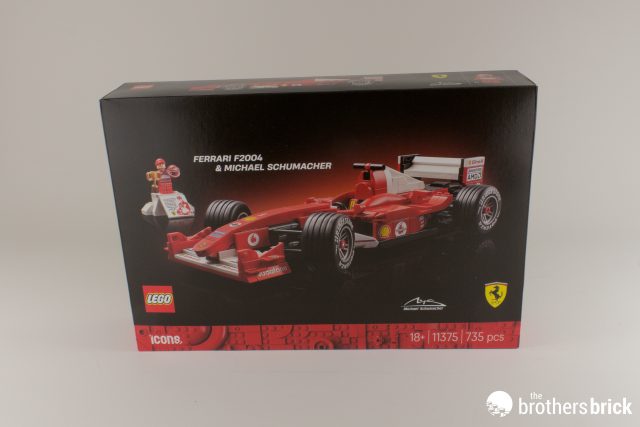
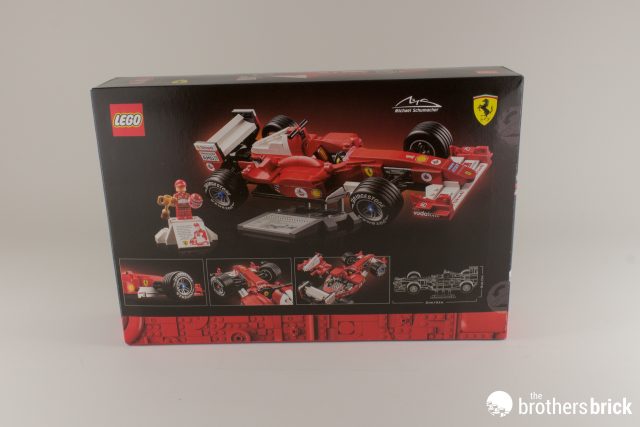
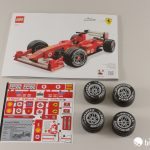
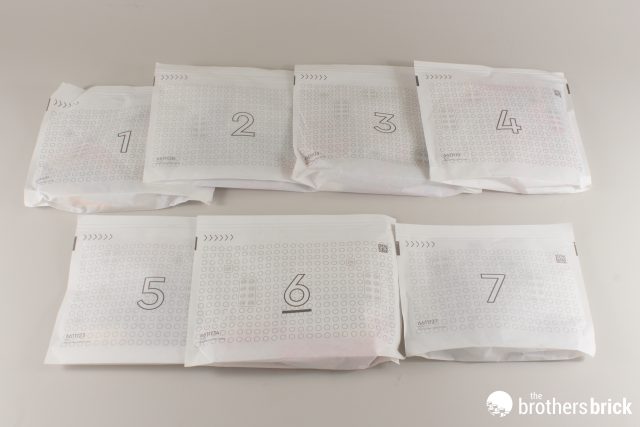
Inside are seven paper bags, the instructions, a reasonably big sticker sheet, and four glorious dual-moulded wheels that we’ll look at later.
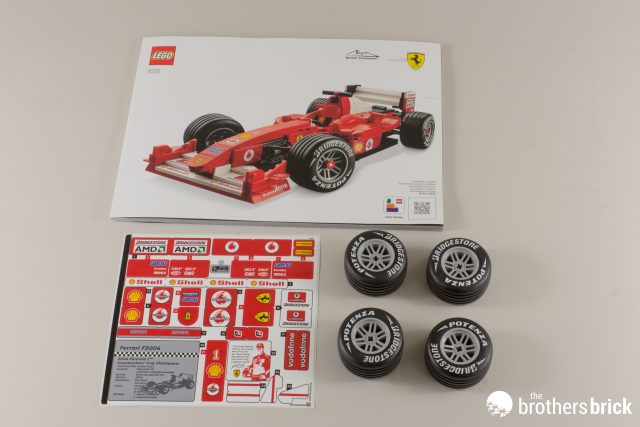
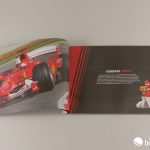
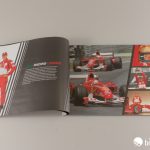
Before we get building, we can read up about the F2004, Michael Schumacher, and their respective exploits. Some of those publicity pictures look decidedly mid-2000s!
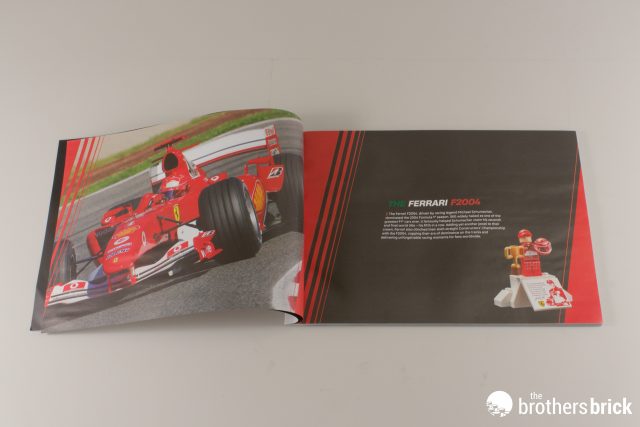
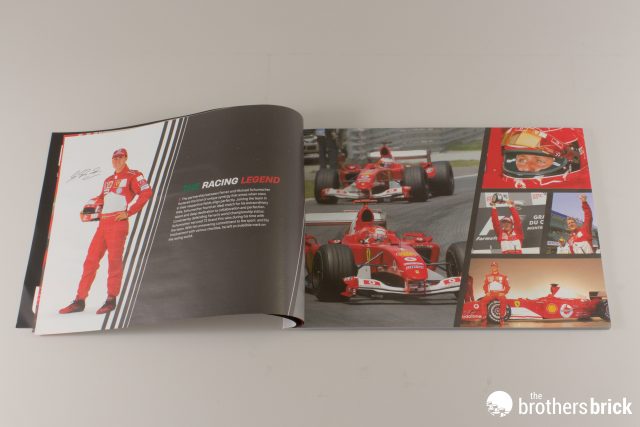
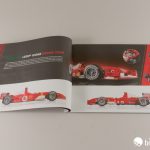
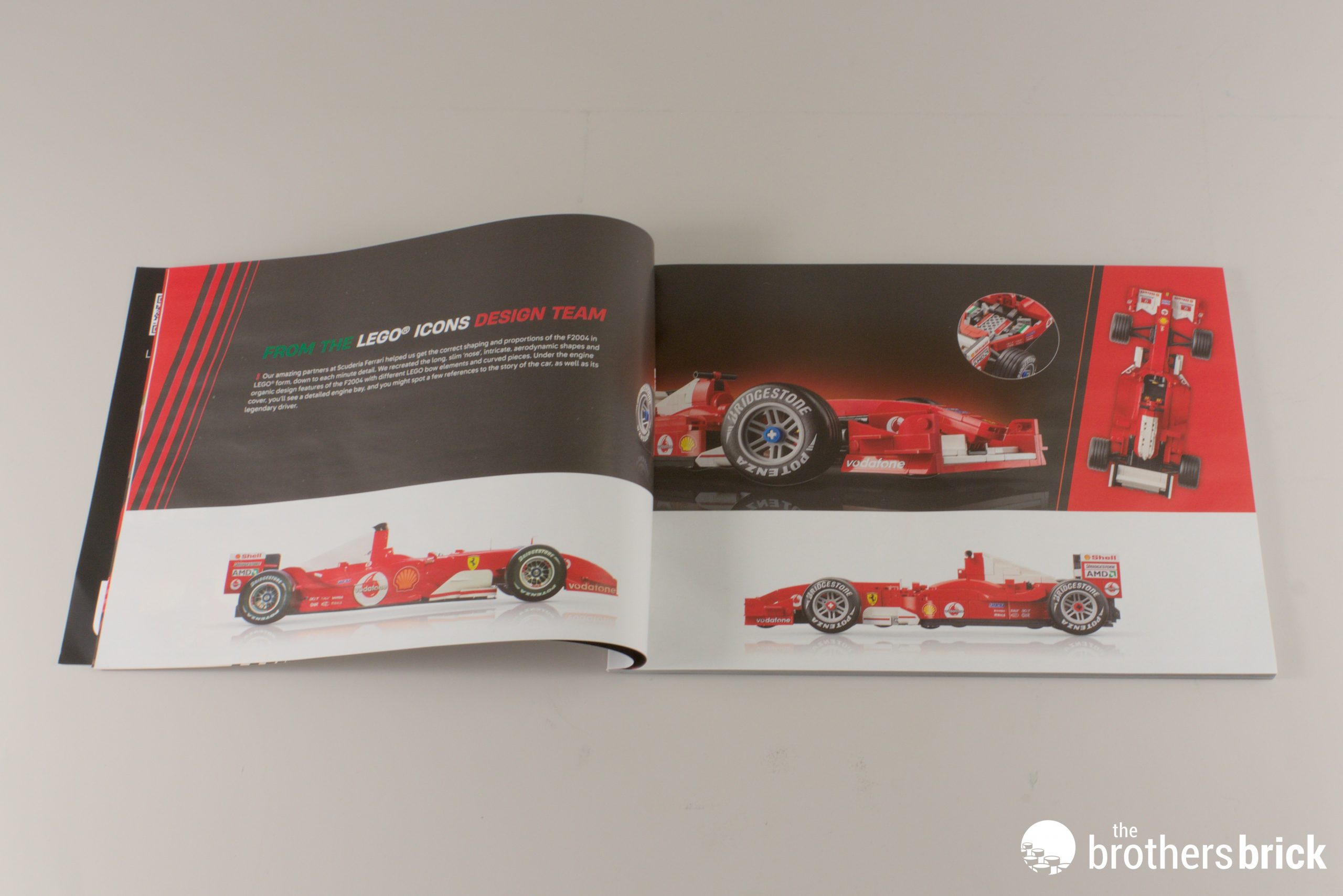
I’ve mentioned before that sometimes, these comparison shots between real-world subject matter and LEGO model are not very flattering. Not so here; no spoilers, of course, but it’s looking promising based on our final double-page info-dump.
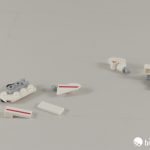
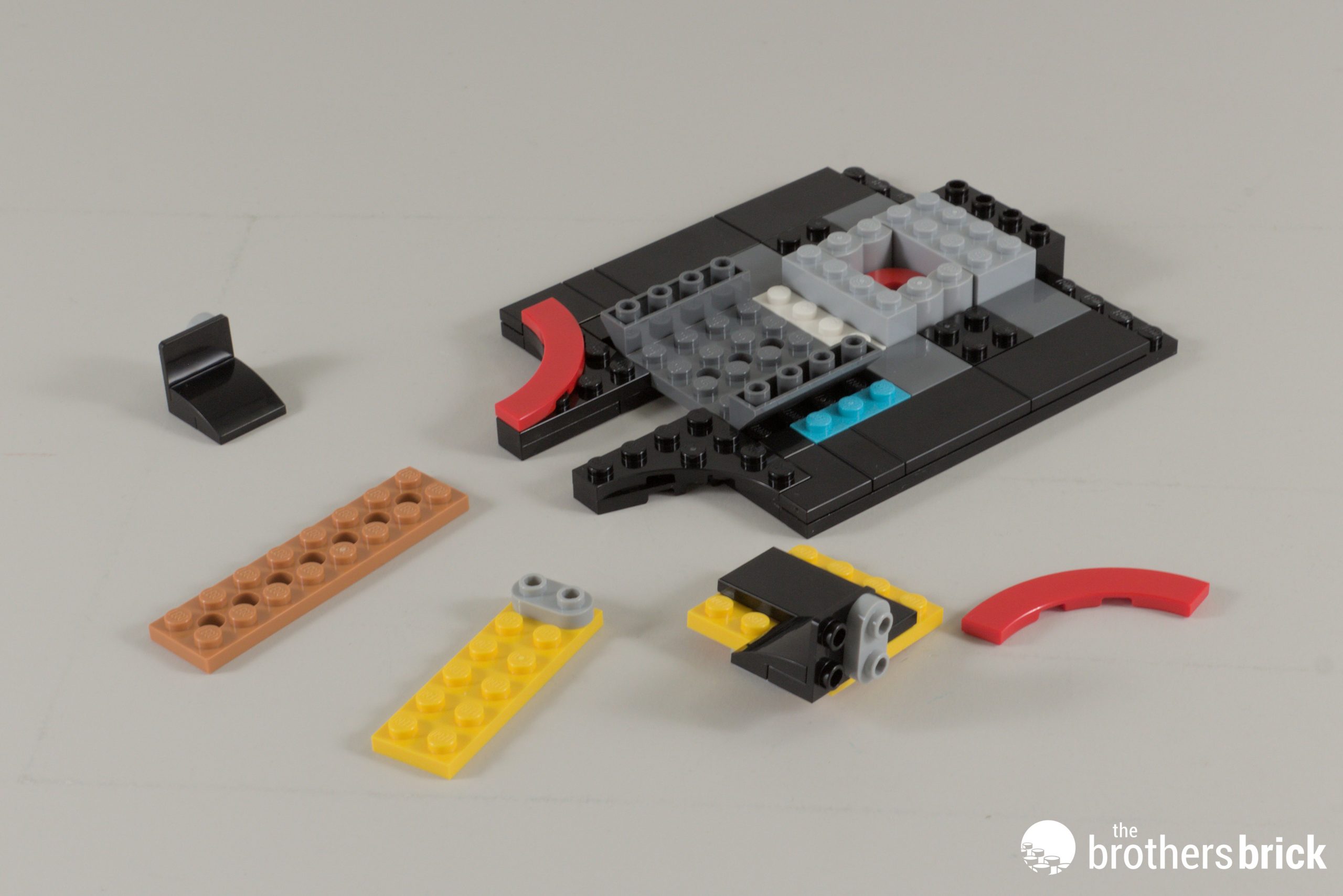
To make a judgment on that, we first need to build the thing! And right off the bat there’s a detail I really like. F1 cars have what’s known as a ‘plank’ underneath, which allows the officiators to control ride heights. Run too low, you’ll wear out your plank, and that’s an on-the-spot disqualification (as McLaren found out towards the end of last F1 season). This vital bit of the cars is included here in the form of two 2×8 medium nougat plates.
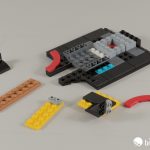
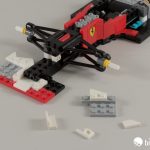
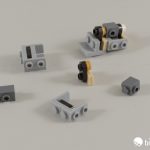
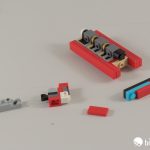
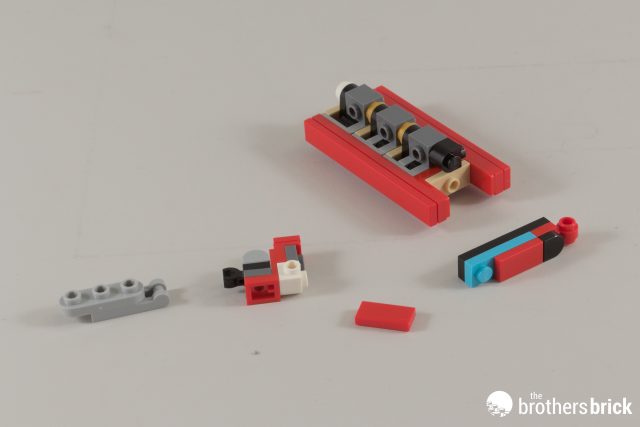
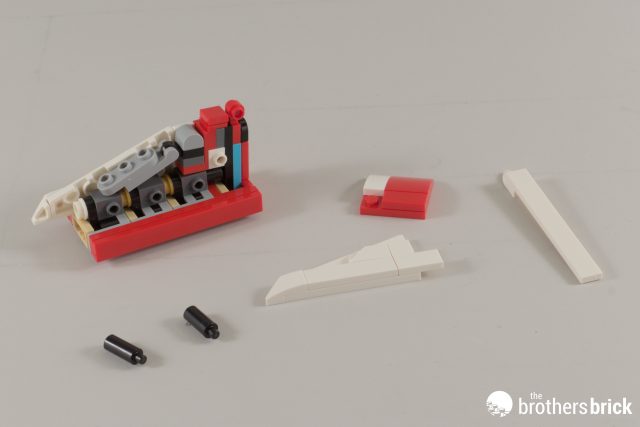
As we build up the rear of the chassis, we jump between the rear suspension and Tipo 053 V10 engine. The suspension uses the same neat integration of driveshafts as the previous cars. The engine also has some nice details – and parts! We have two 1×4 cheese slopes forming the cylinder heads, although they do have stickers applied.
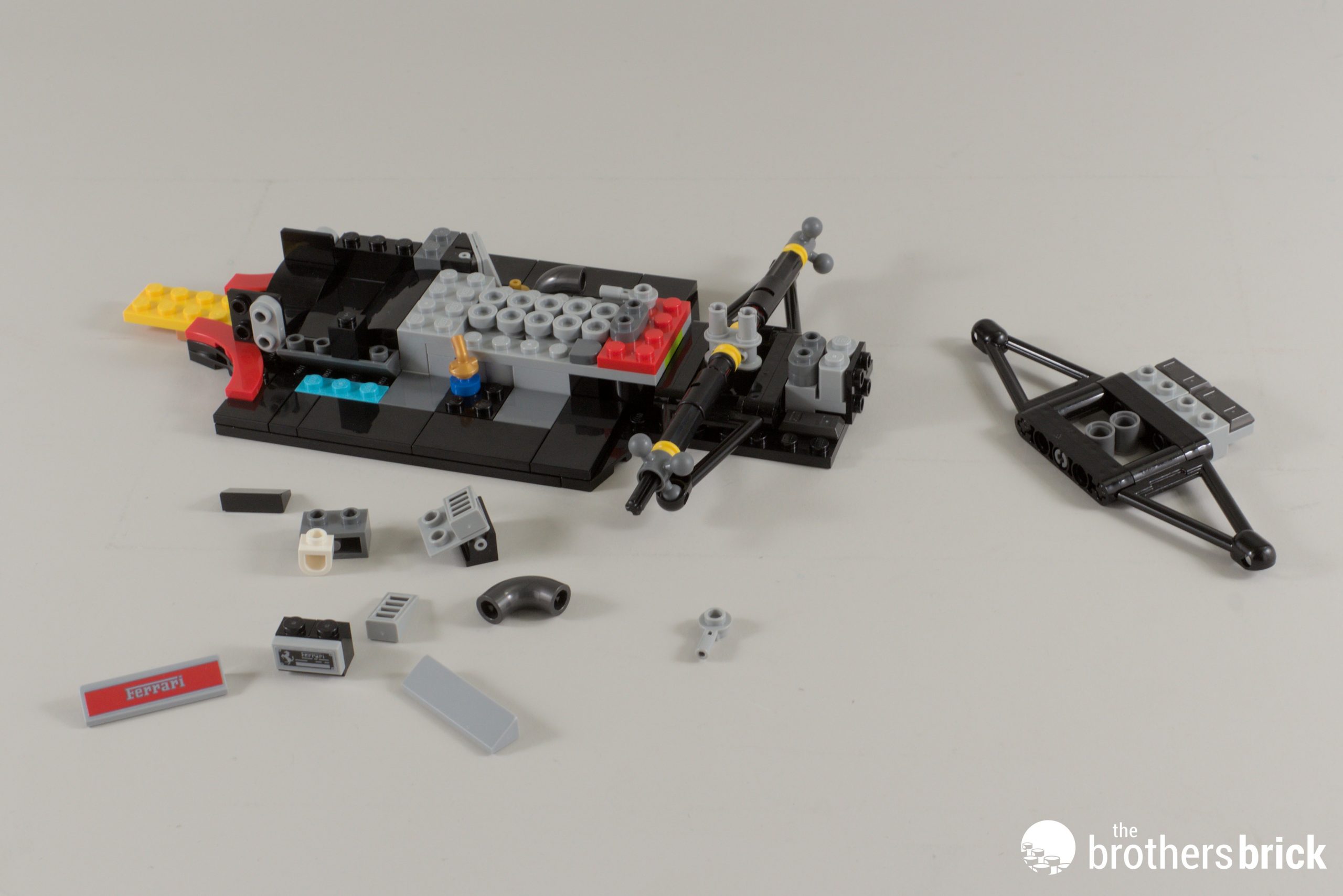
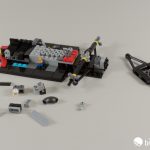
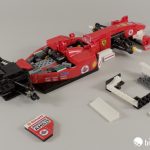
As of the third bag, we move on to the front end, starting with some sideways brackets to help build things up. Until the sides go on, there’s only a two-stud connection to the rest, so it doesn’t feel especially sturdy until the end of the bag.
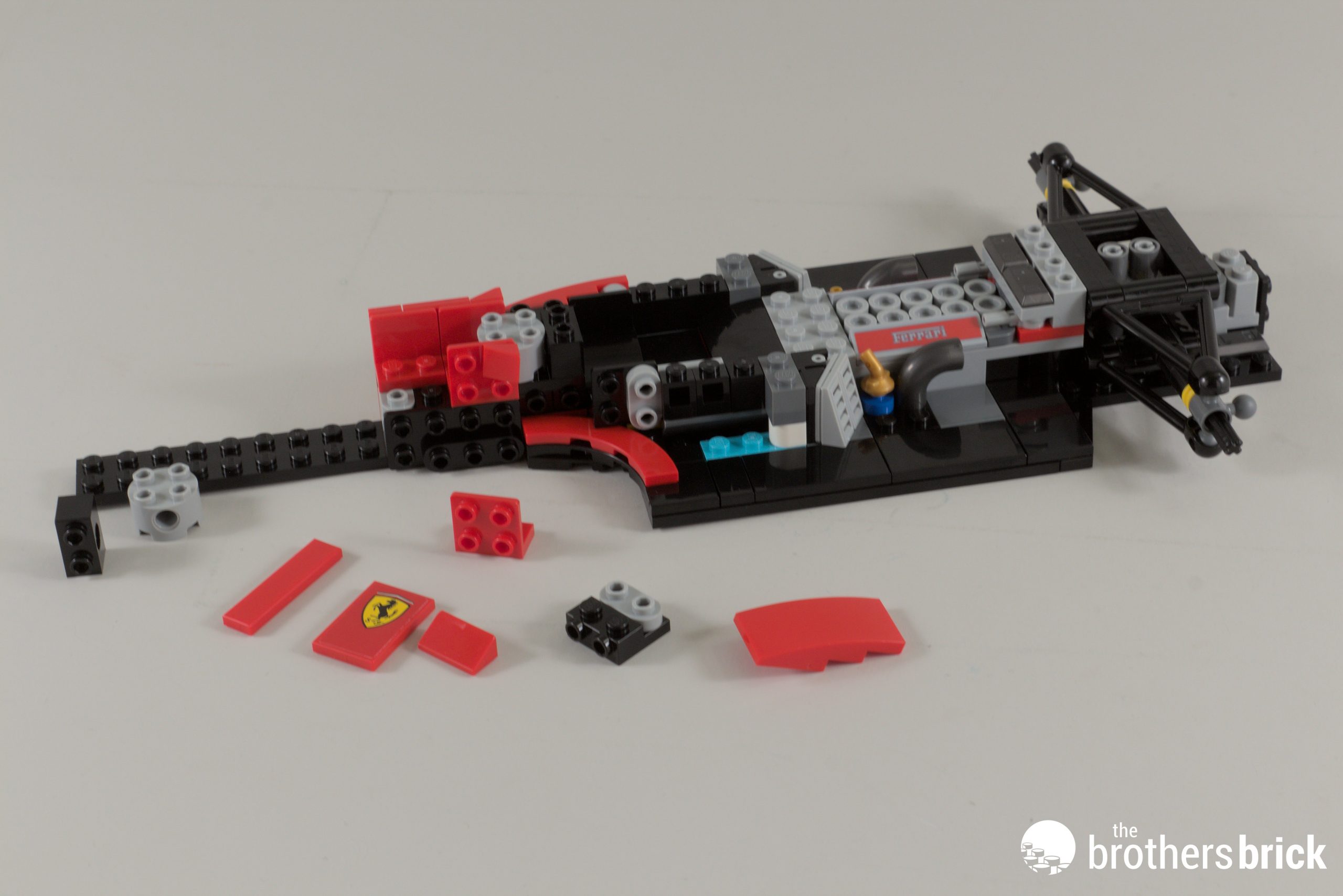
Much like the rear, the front suspension and steering system is pretty much the exact same as the Williams and McLaren cars that came before this one. If it ain’t broke, don’t fix it, I guess.
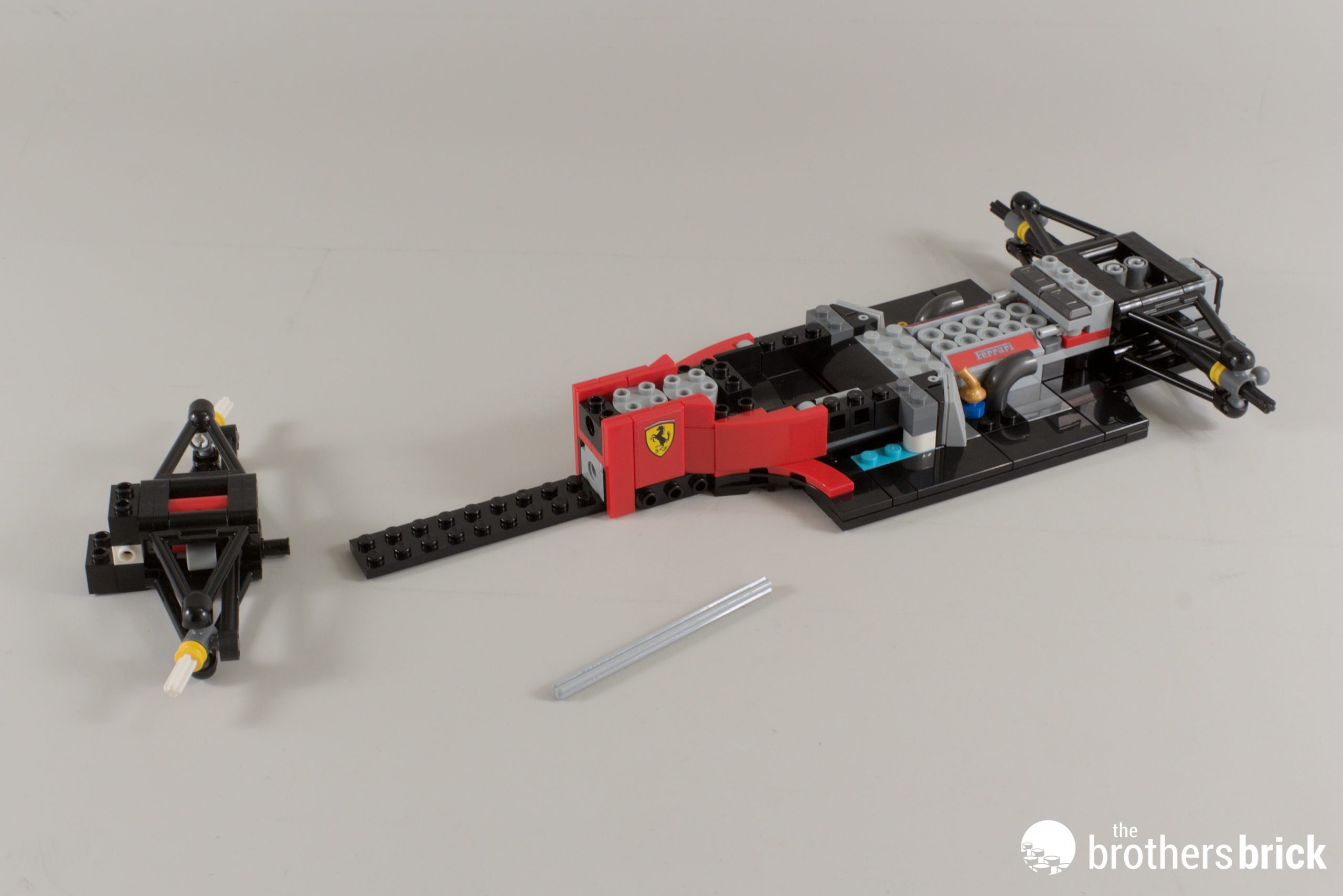
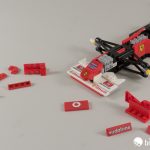
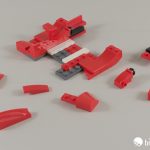
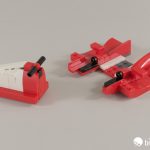
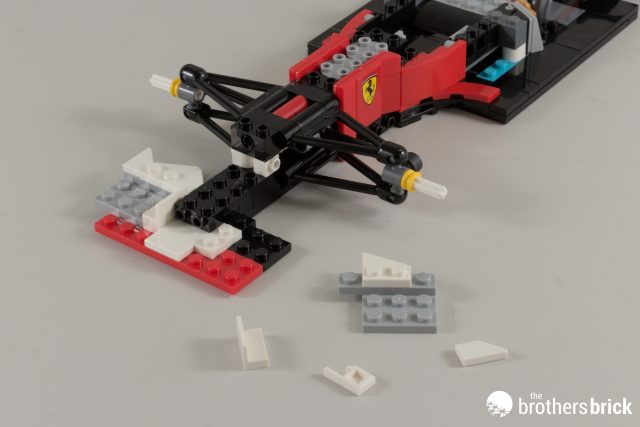
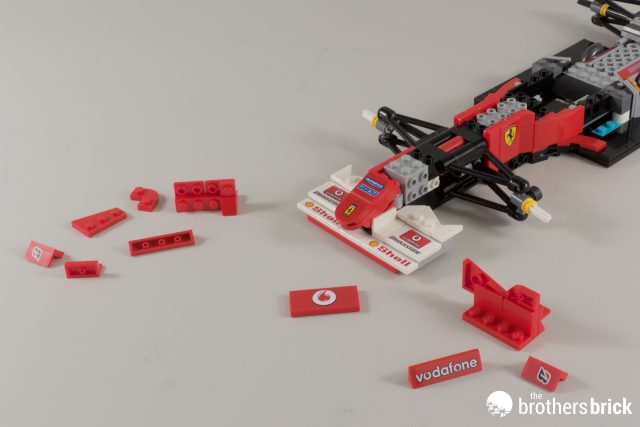
The more external parts we begin to apply, the more stickers we see, and as we get to the front wing that goes into overdrive. While not as complex as modern wings, there are still plenty of little tricks and fairings reproduced with wedge plates and panels. In the midst of all this is a sideways hinge which sets the angle of the nose tip.
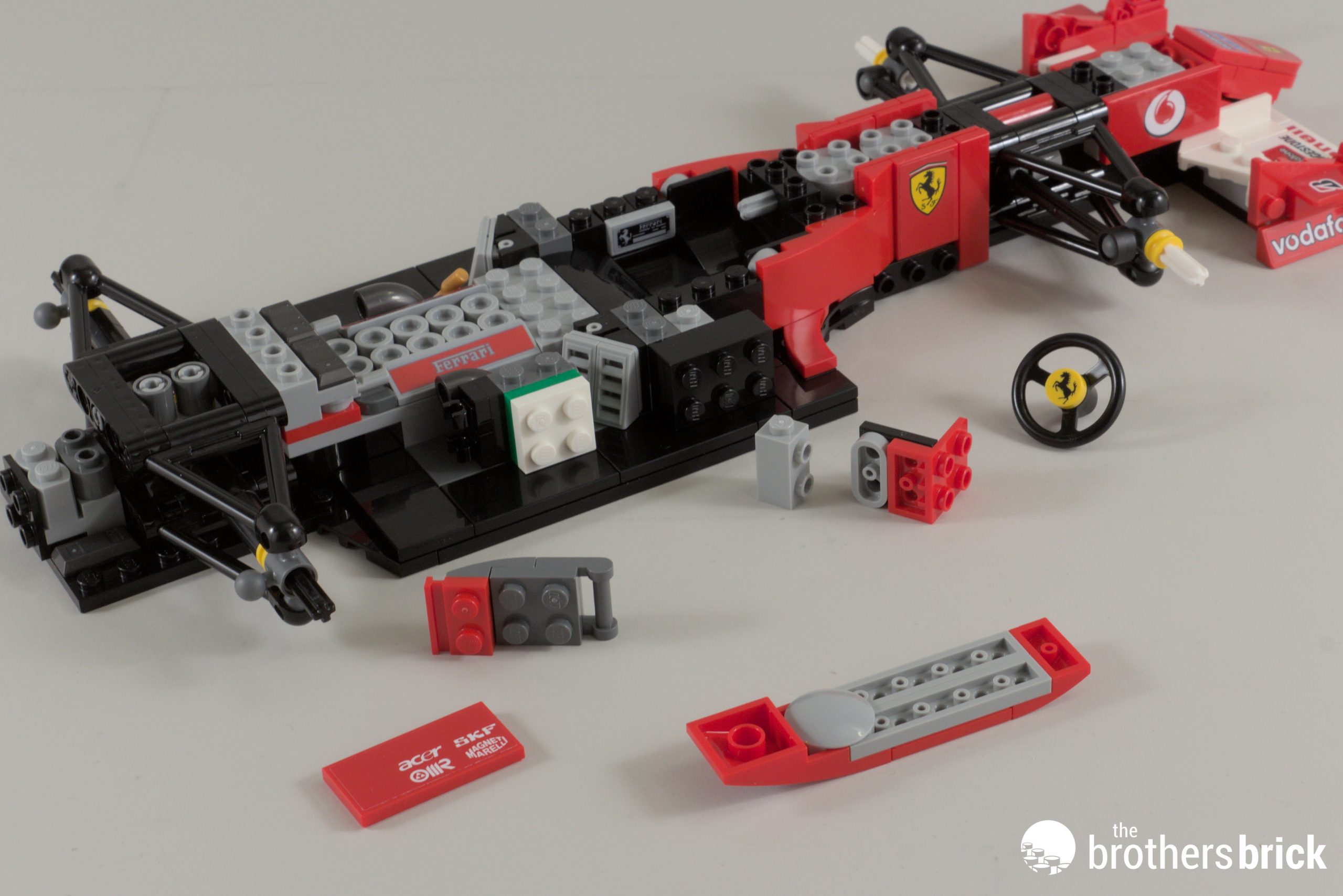
One of the few printed parts is a nice one, though: a round 1×1 tile with a Ferrari logo, of which we get one plus one spare. The steering wheel on which it’s mounted is far too round for a modern-era F1 car, though. The pilot-style yoke would’ve been a much better choice.
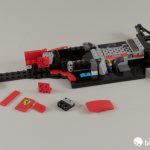
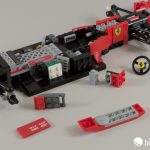
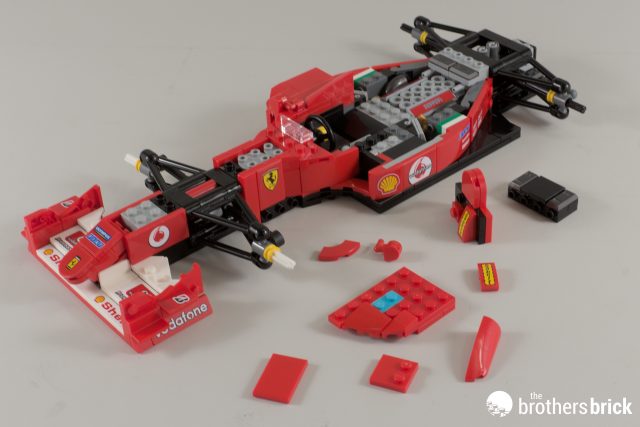
The wheel is basically the last interior bit to go in, though – it’s all bodywork from here on out. The Sabelt stickers make a welcome return for the seat harness, and a smattering of curved slopes help to smooth out the edges of the car. In truth, I’m surprised by how few of htese there are, given that by the mid-’00s, F1 cars were becoming far more aerodynamically sensitive than at any time before.
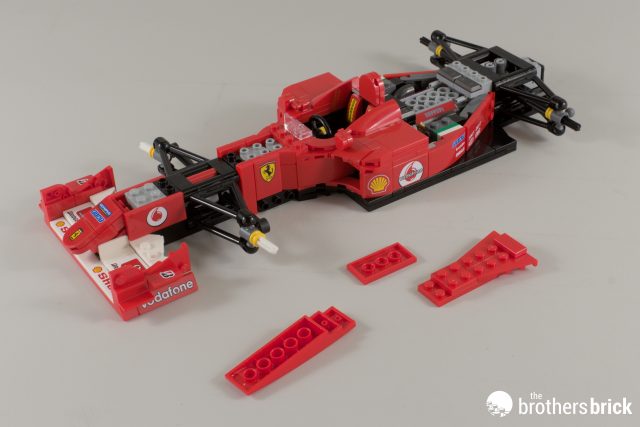
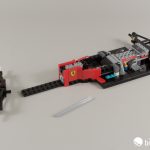
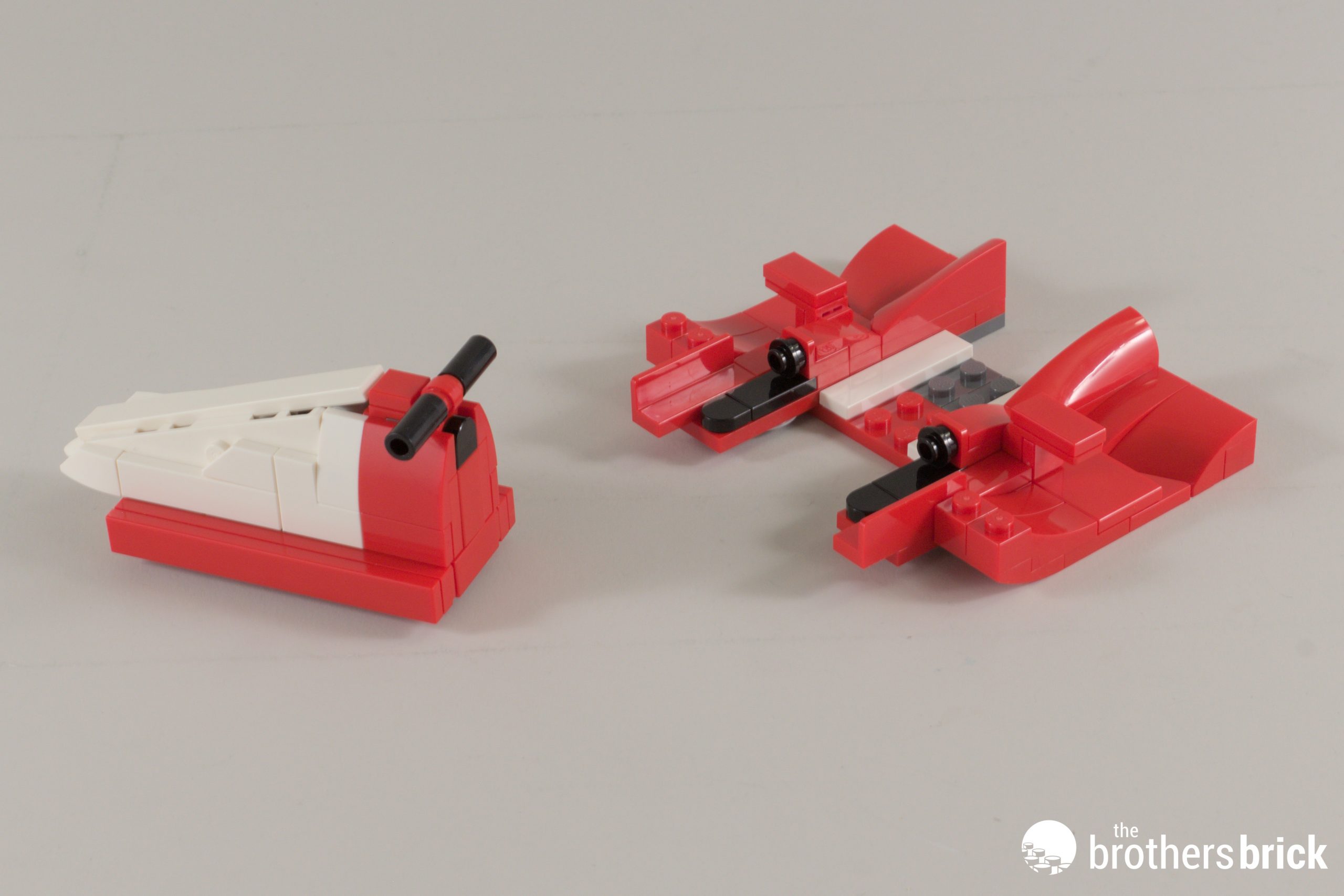
And as if to prove the point, we have some more aero devices to build next. First up, the area ahead of the floor, known as the bargeboard (don’t ask me why). These are fiendishly complicated bits of engineering designed to manipulate air around the car and into the cooling ducts. Here, some ball joints and 3.18mm bars allow a Technic panel to be connected at just the right angle. Nice! Although I can’t say the same about the stickers which adorn them. They were a pain to apply.
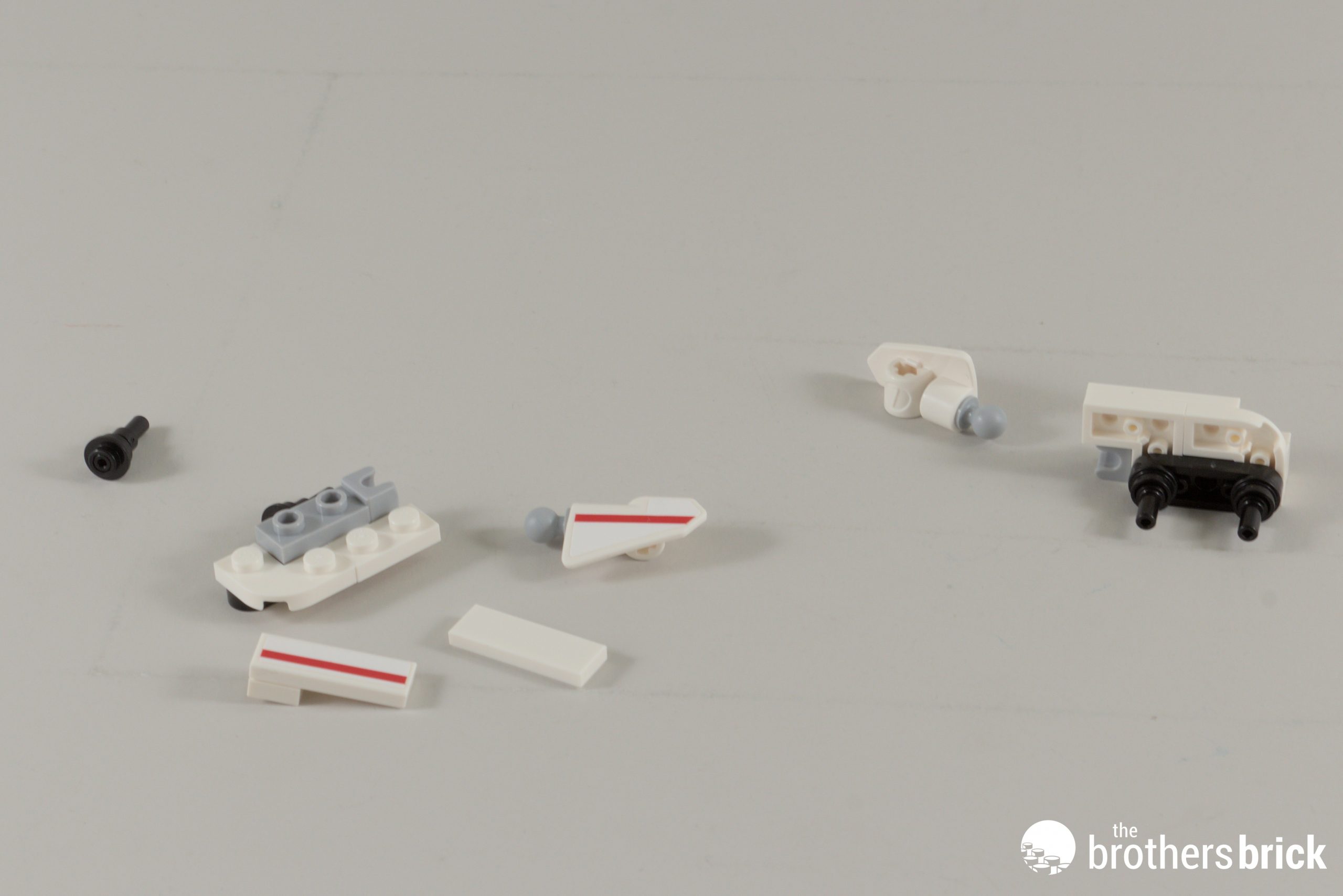
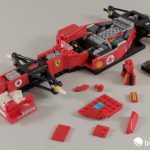
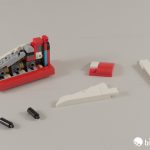
After slotting these in, it’s over to the rear wing. The main element is mounted on brackets that are sandwiched between the endplates. While these endplates are covered in stickers, the main part of the rear wing (a new re-colour of the six-wide ramp piece, incidentally) is completely devoid of them and looks unusually blank. It’s for good reason though: for most of its racing life, this area sported the logo of a tobacco company. We can’t be having that in a LEGO set.
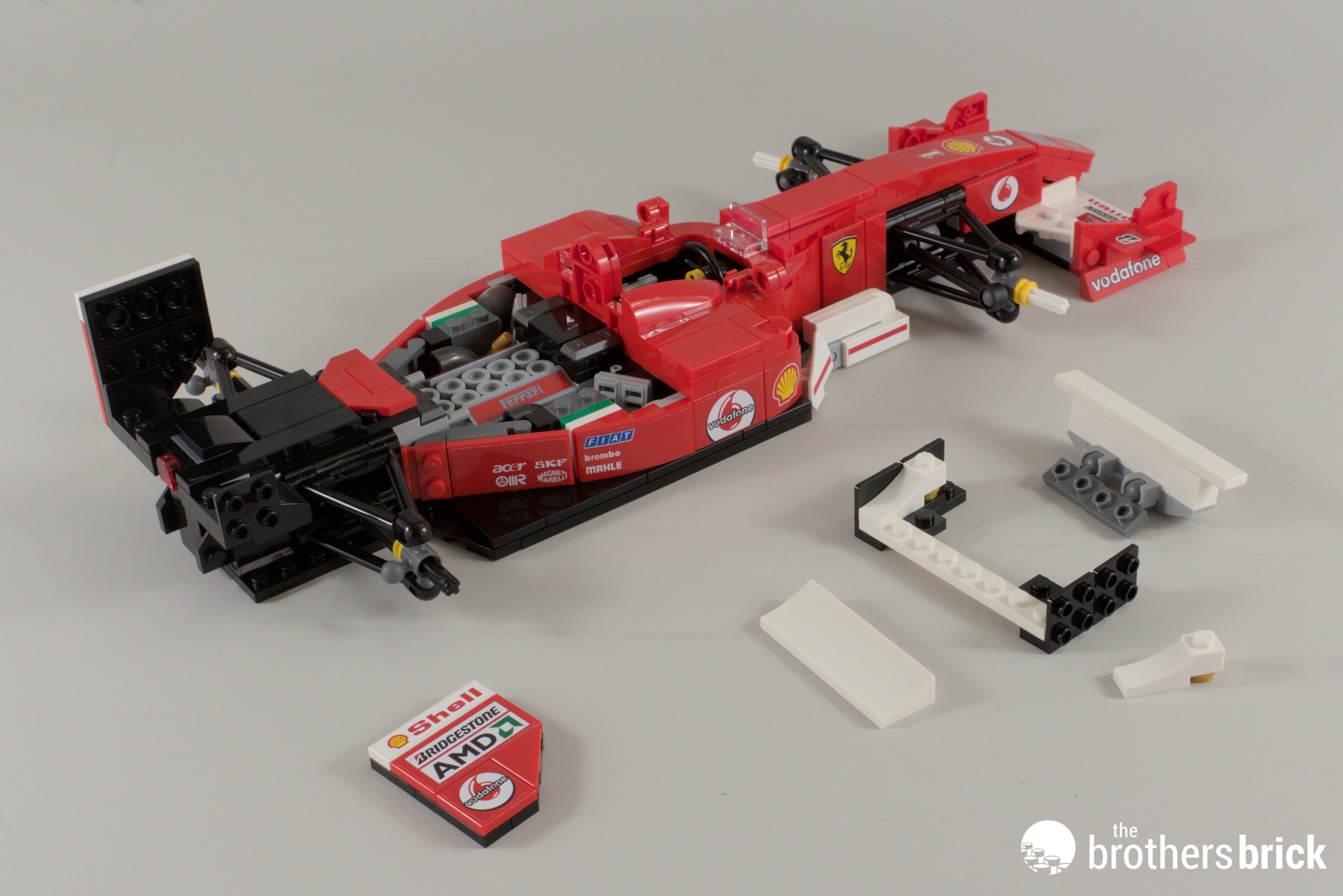
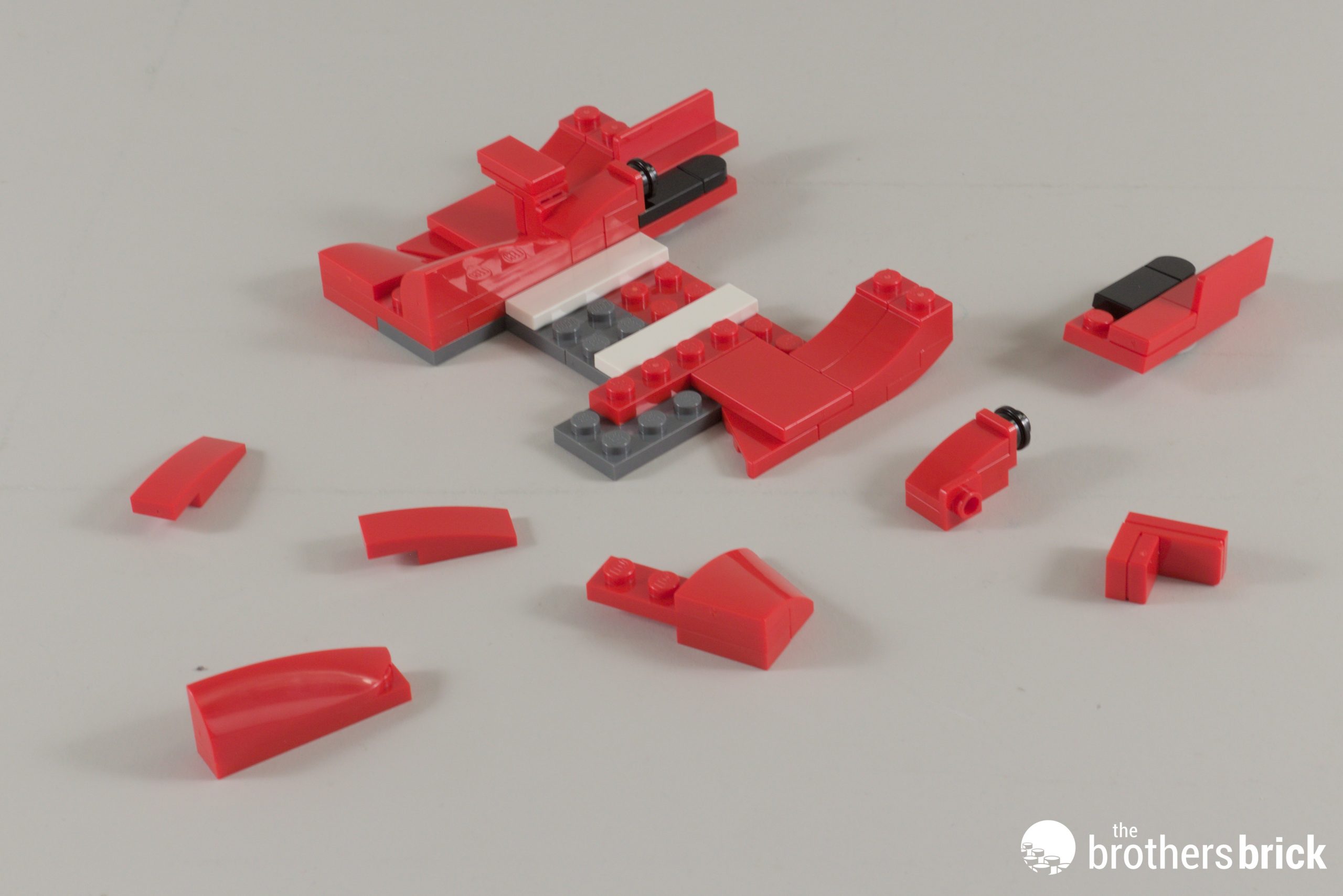
The same is true of the engine cover, so most of the rest of the build is sticker-free. The base of this includes some of the aerodynamics that were revised for the 2004 season. These are the curved elements at the back, and the sideways bracket-and-tile assemblies.
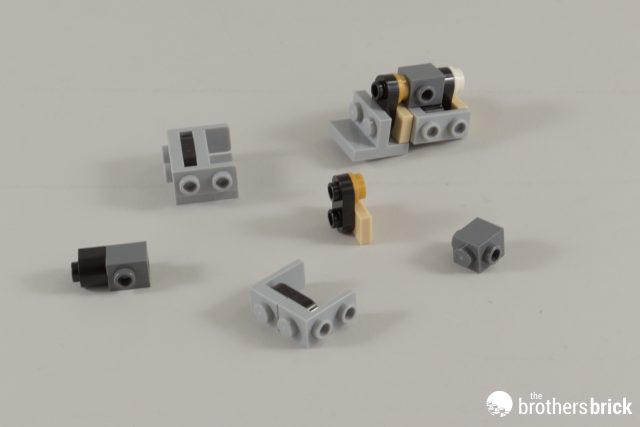
And then the airbox. This has a rather intricate core, transitioning neatly between two-stud and one-stud wide SNOT. You’ll notice a few gold 1×1 round studs hidden in here, and there are a few hidden around the car in seemingly odd places. I guessed that they represented each of Michael Schumacher’s 7 championships, and sure enough, the instructions tell you to count them up at the end.
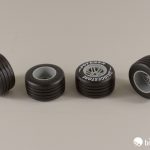
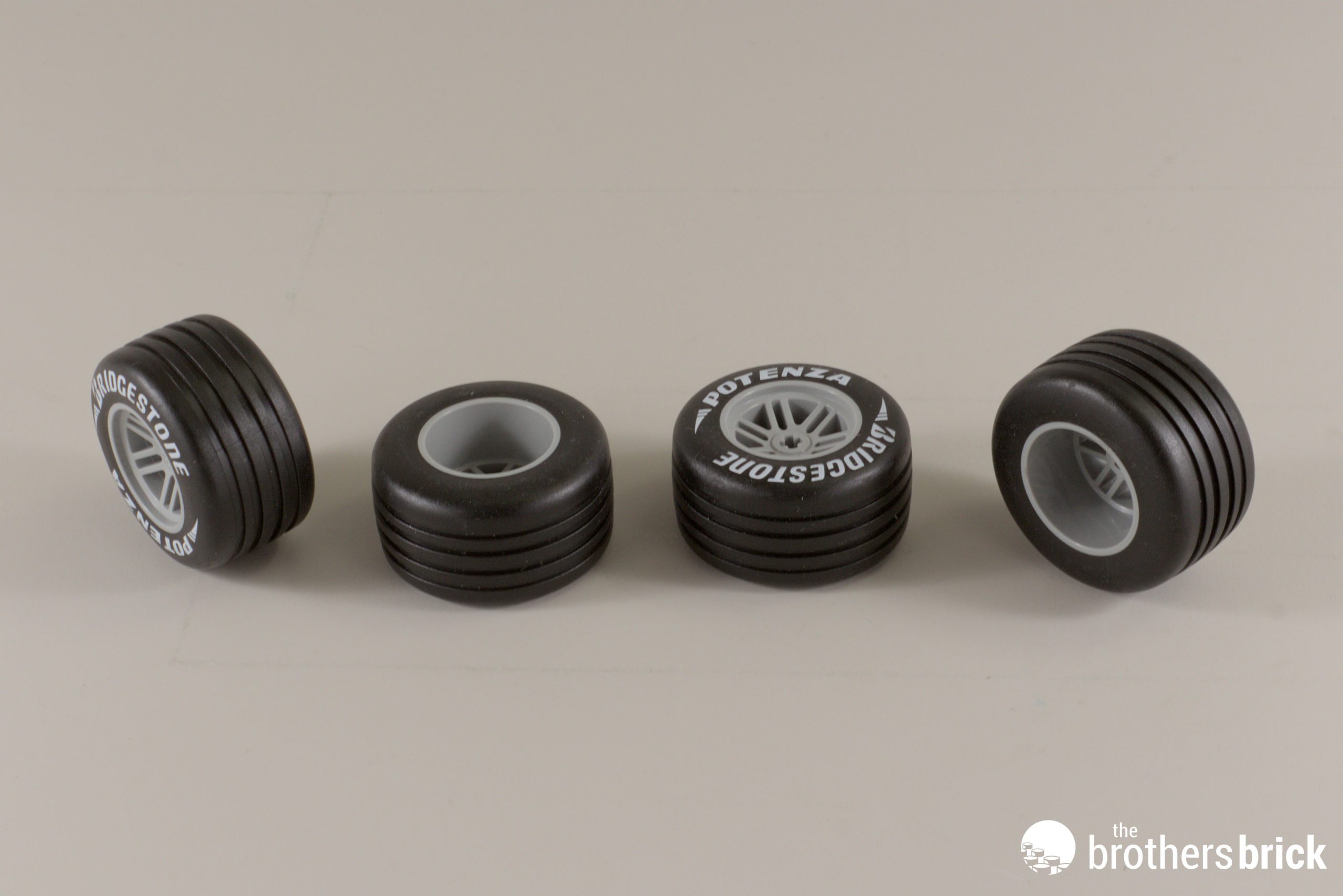
This sits on the car, and then it’s just the stand to build. But first let’s talk about wheels! Between 1998 and 2008, Formula One mandated grooved tyres in an effort to reduce grip and therefore speed. It’s a key part of the look for cars of the era, and for this car we have four new dual-moulded and printed Bridgestone Potenza tyres. The spokes on the rims are too thin, and they’re all the same size rather than the rear ones being marginally wider. But otherwise, they look fantastic.
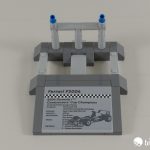
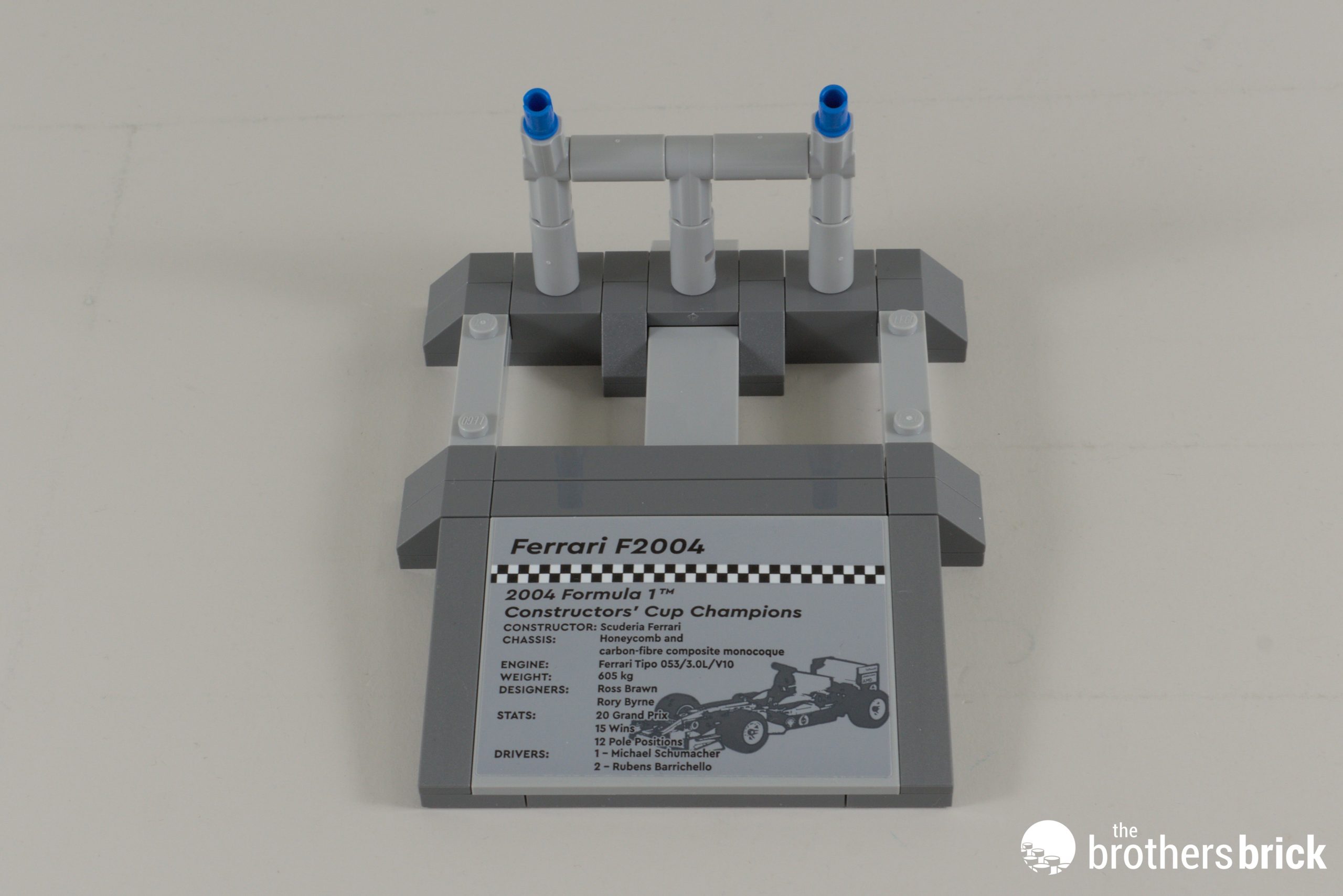
These are attached with Technic half-bushes that are different colours left to right. The left-hand ones are newly recoloured to red, but I forgot to take a picture of those (they’re visible in later pics). Instead, have a photo of the car’s stand, complete with typo-free sticker.
The minifigure
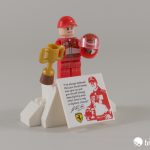
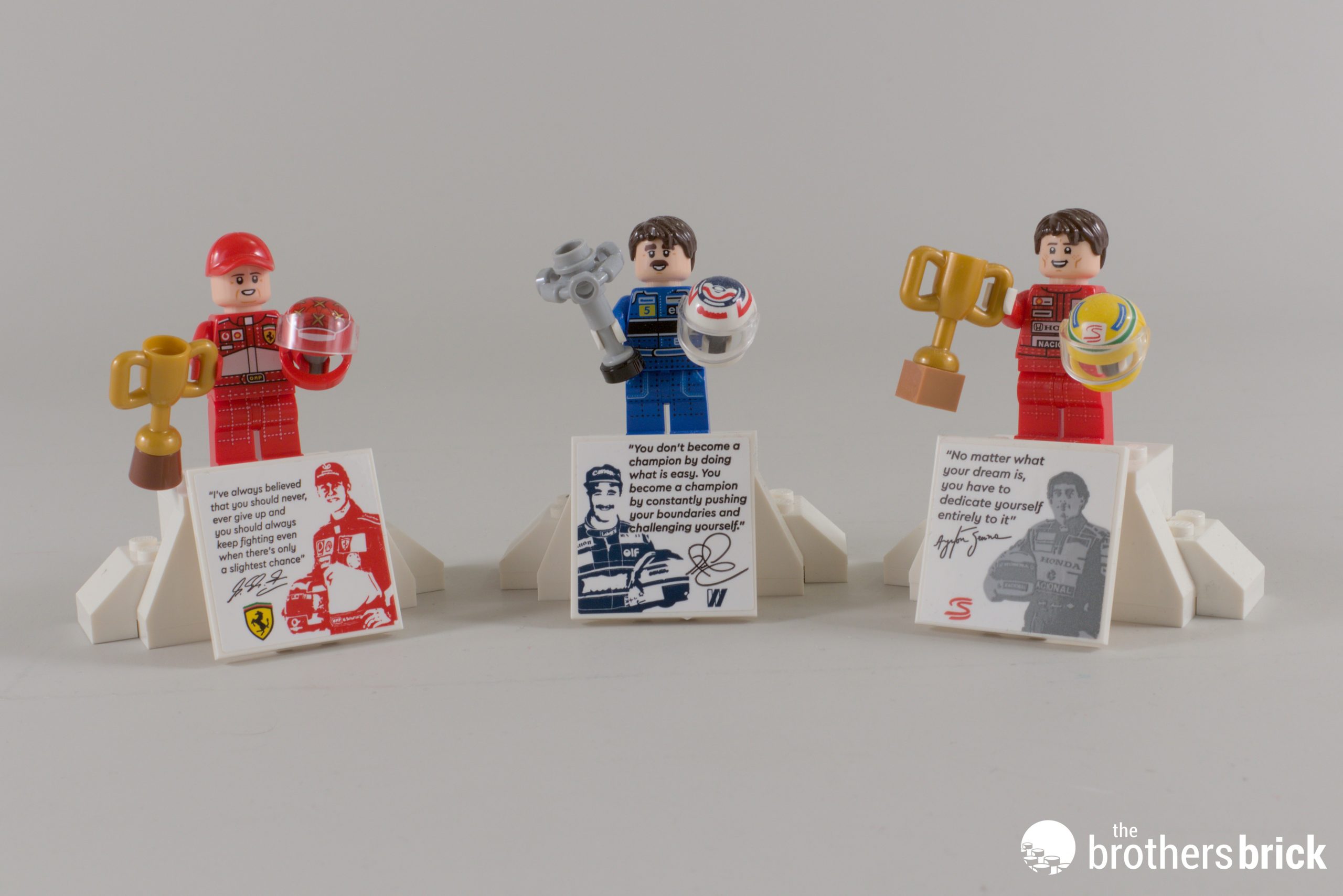
We’ve seen Schumi in minifigure form three times before, but they all featured – *shudder* – torso stickers. That’s right kids – we used to have to apply stickers to our minifigures! Fortunately, we’ve moved on from such dark times.
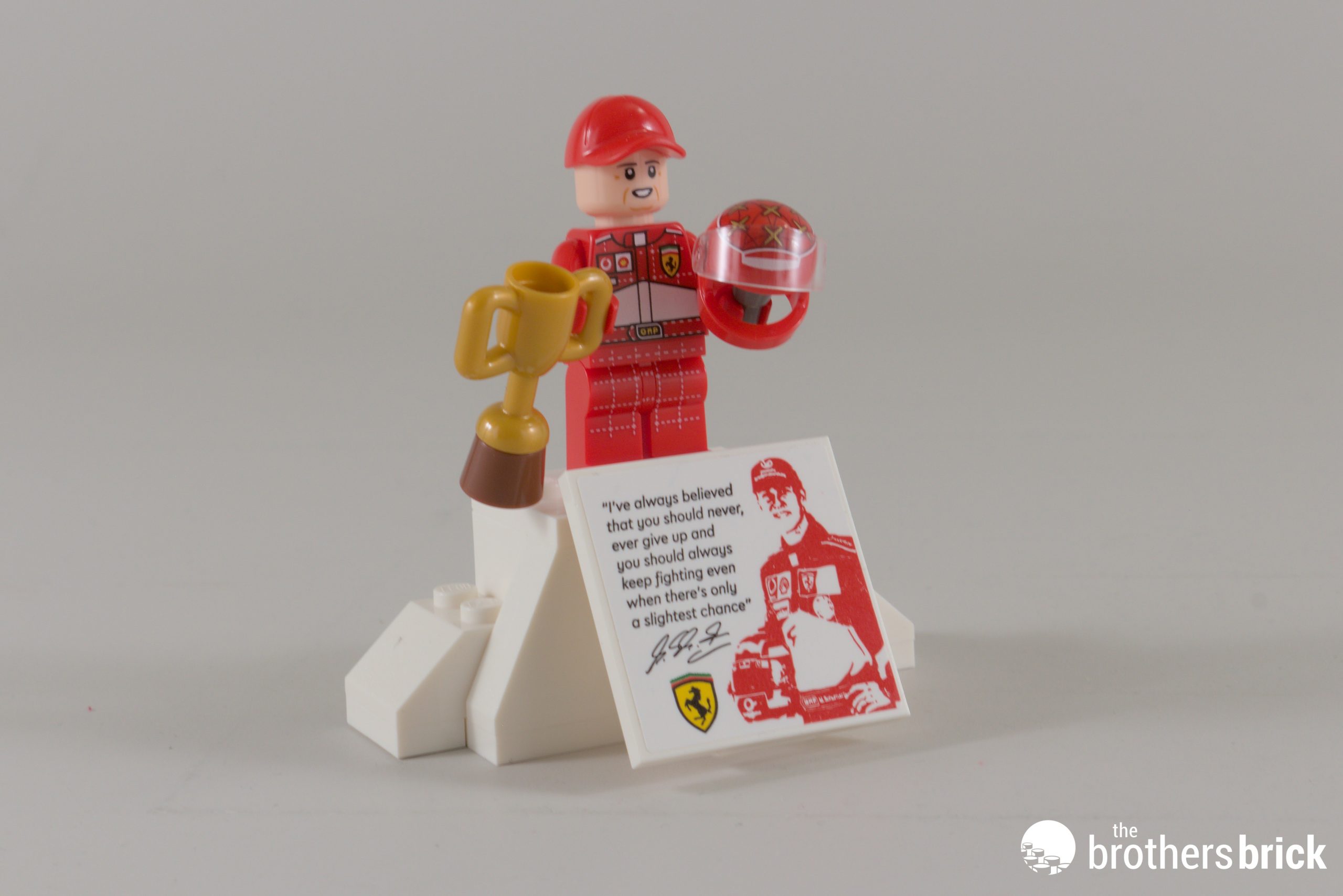
I own a couple of the original Schumacher figures (albeit in storage), and in my rose-tinted memory they didn’t look too dissimilar to this. But in truth, this is a vast improvement over those. It’s a great figure in its own right, featuring leg and back printing. The white-on-red printing isn’t even that bad!
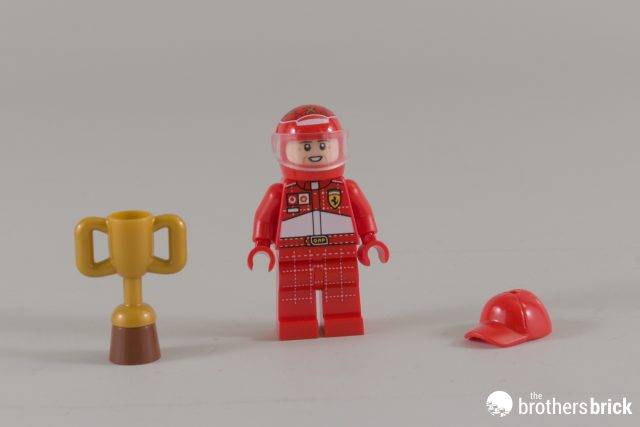
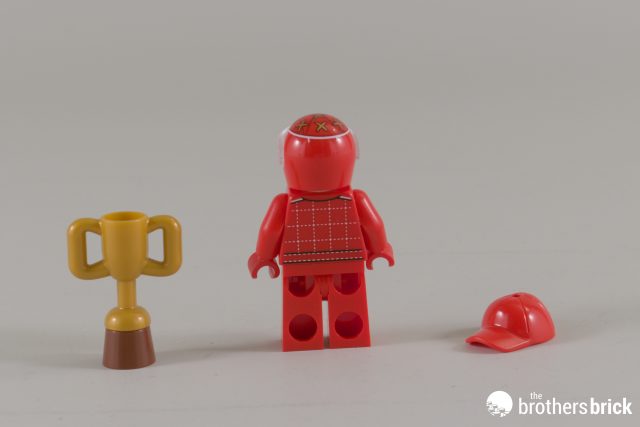
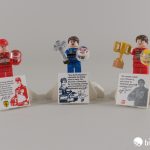
He compares very favourably to Nigel Mansell and Ayrton Senna. The three did race each other in the 1991 and 1992 seasons, although Michael was at Benetton rather than Ferrari at the time. The only thing he doesn’t have is a reversible head, like Senna and Mansell have, owing to the inclusion of a red cap rather than a hairpiece.
The finished model
Given I grew up around the time Schumacher was breaking all the records on TV, it’s perhaps little surprise that I’m quite fond of the Ferrari F2004. The real thing is beautiful in my eyes. So, too, is the LEGO model!
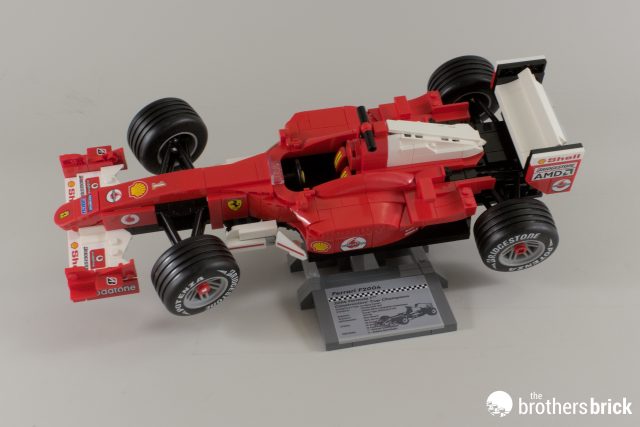
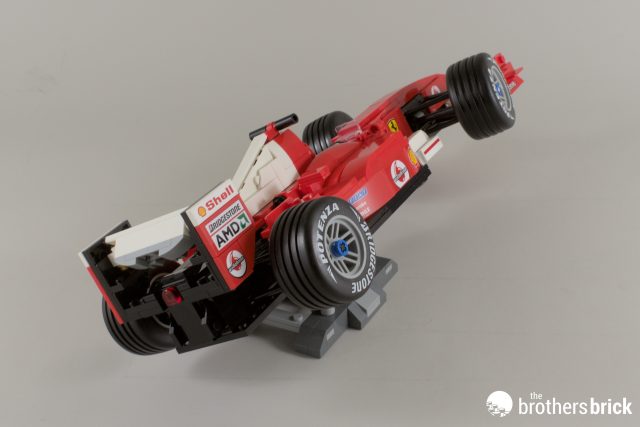
Although the rounded edges of the real thing aren’t in evidence, the shaping of the body is superb. I love the transition of the nose curve! And the little aerodynamic flourishes are great, too.
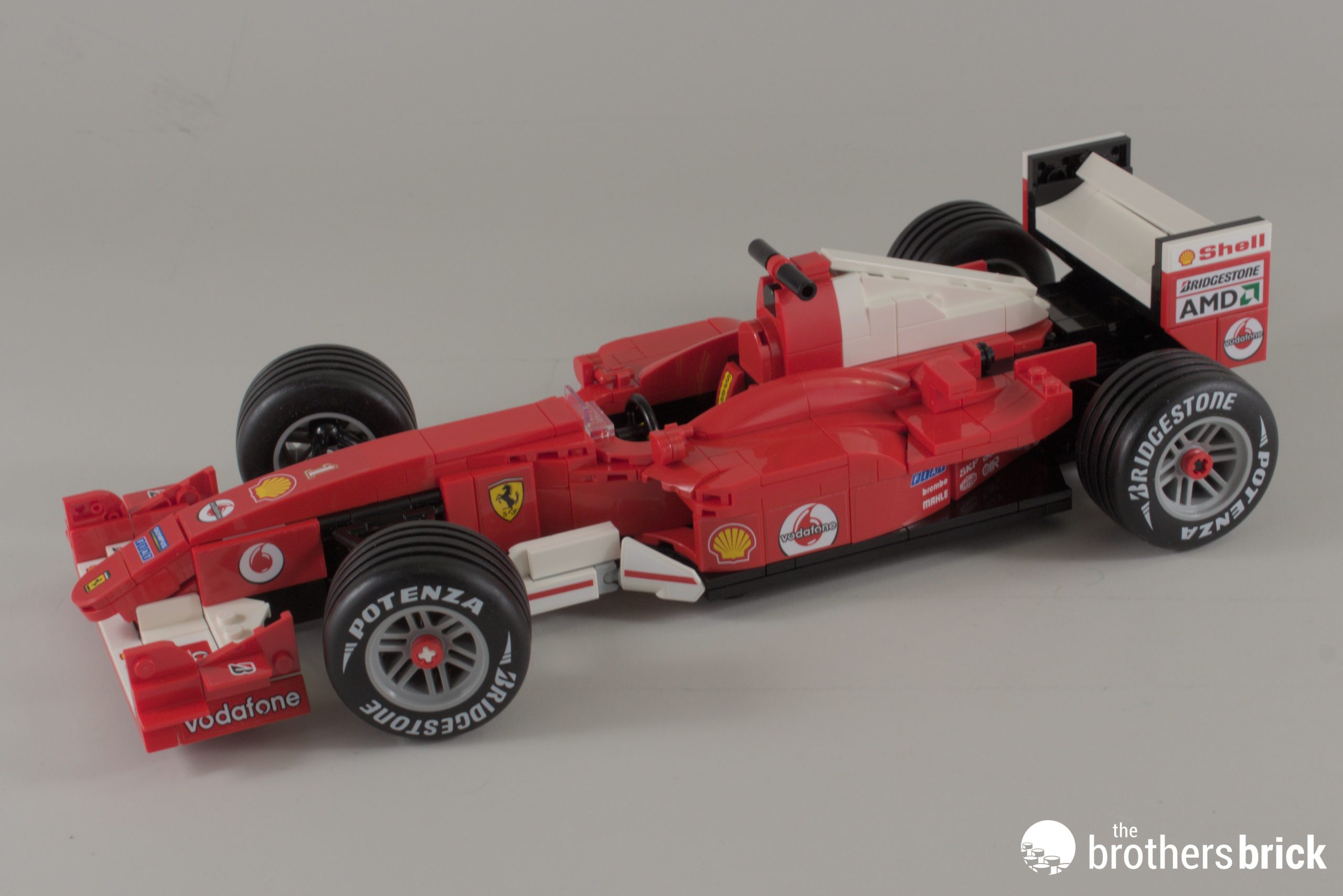
The steering works, and to an extent so does the suspension; there’s just enough play in the LEGO parts to allow for an accurate amount of travel (i.e. not much).
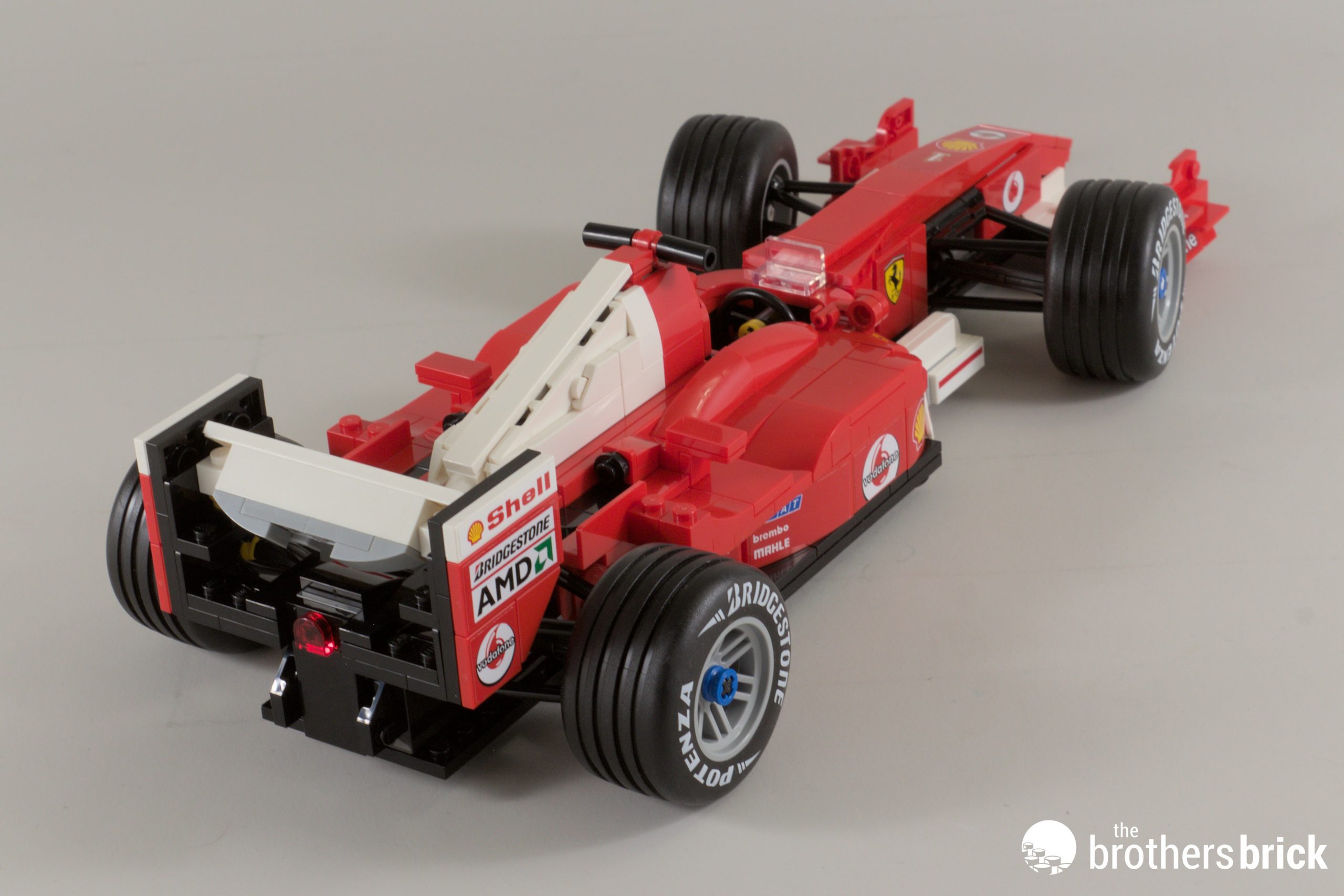
It’s true that the rear tyres should be wider than the fronts, but I find it to be less noticeable than it was on the McLaren MP4/4. Partly as the tyres are wider to begin with, but partly also as the difference in size is not as great in real life. And seen from a lower angle, the wheels do so much to elevate the look of the car.
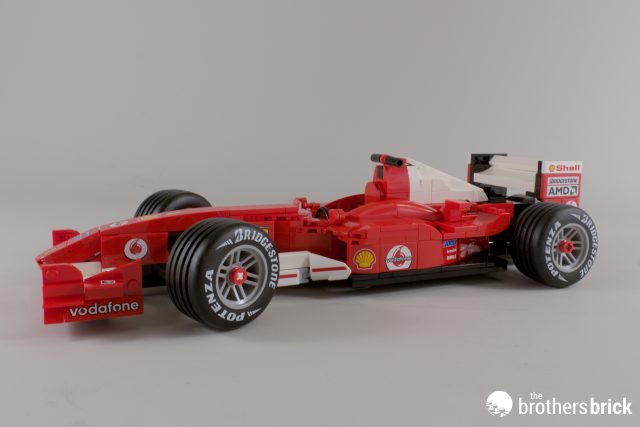
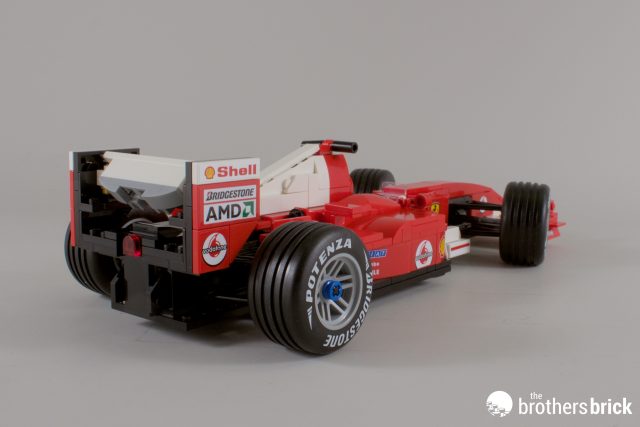
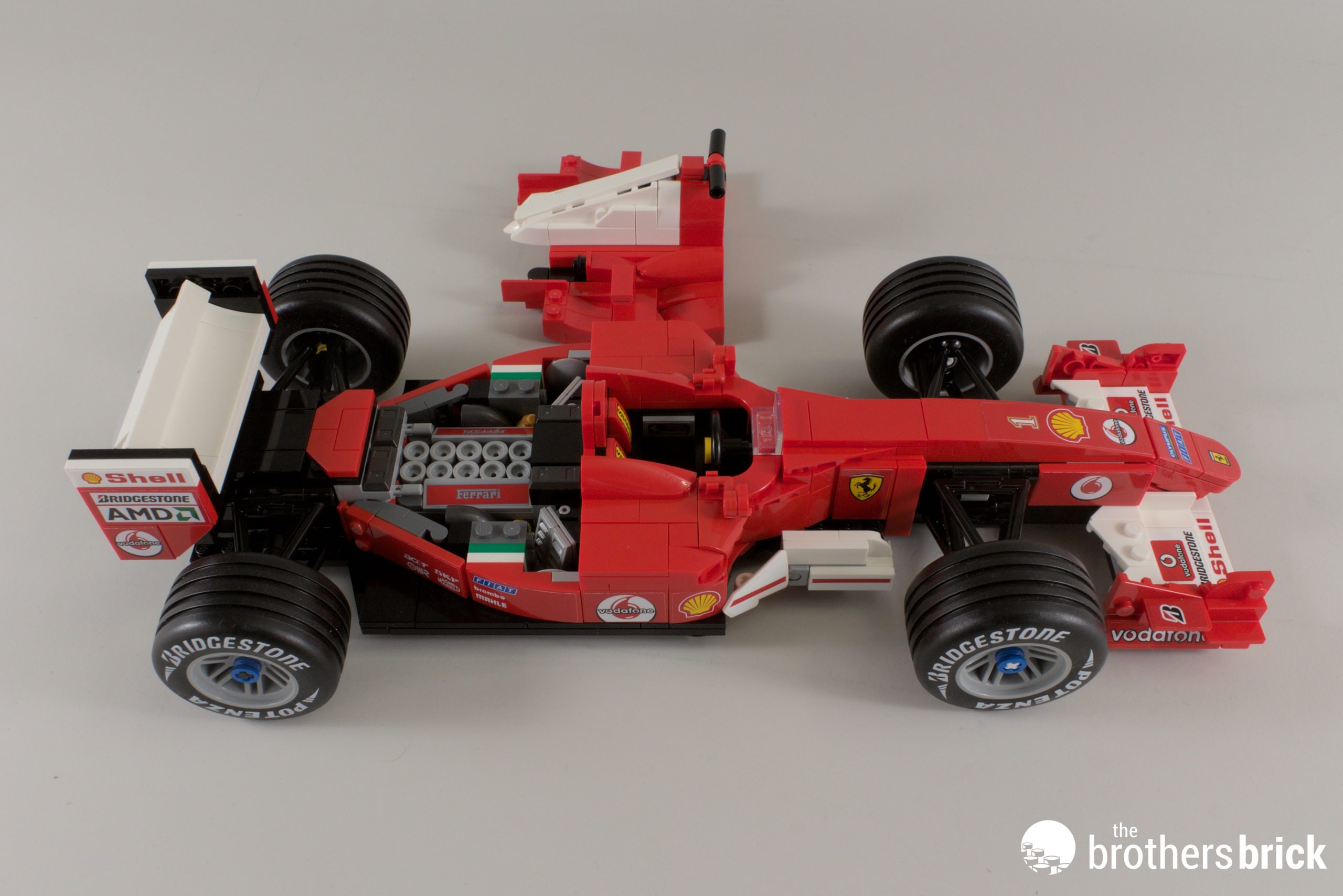
Lifting the engine cover off, the V10 looks pretty good too. I can’t help but feel the engine bay is a little sparse; some whips or string pieces for hoses or wires would make it feel more full. But the tricolore flags are a nice touch. While racing teams have moved on from the days of national colours, Ferrari remains proudly Italian. It feels right that that’s shown here.
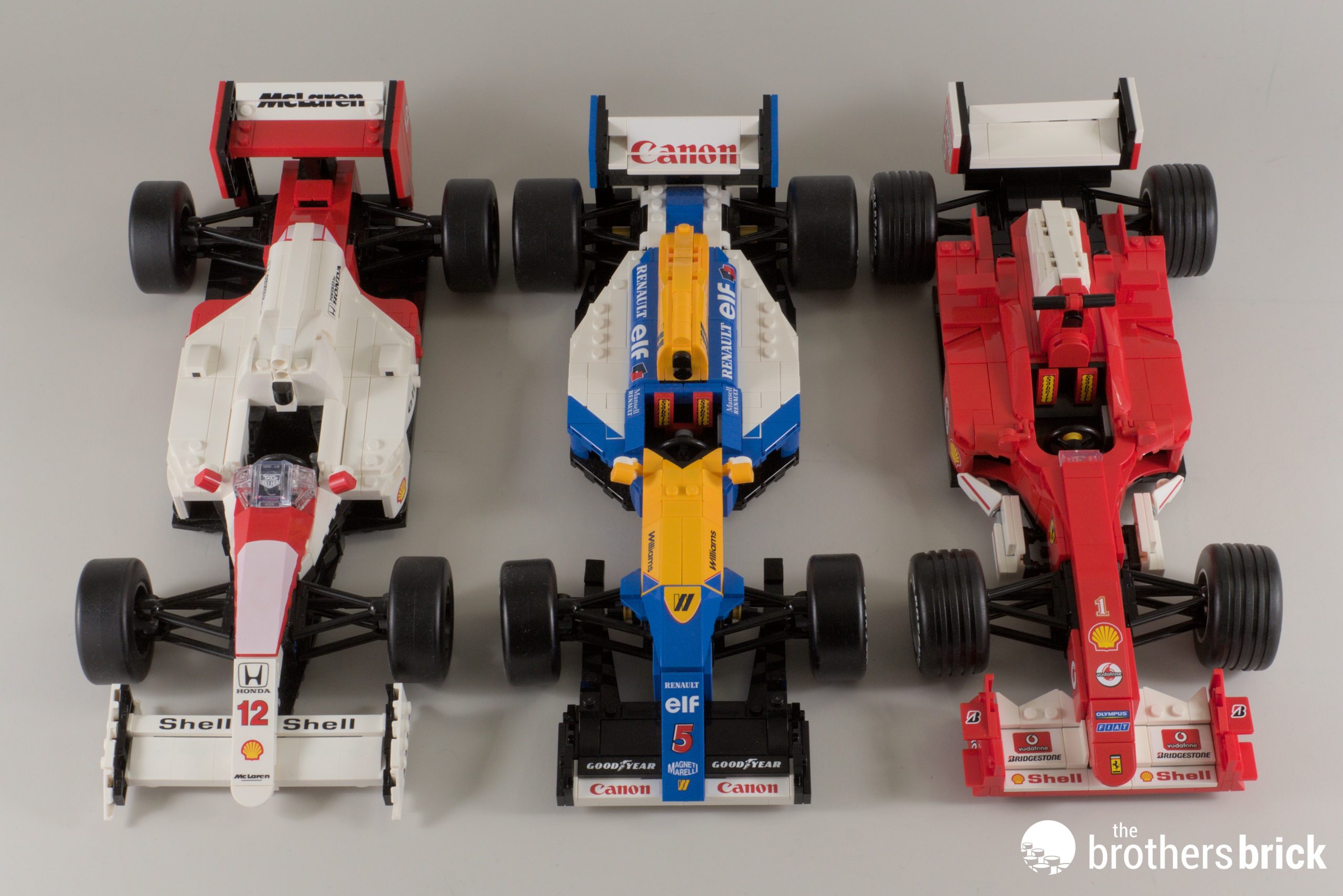
I’ve talked a lot about the Fezza’s LEGO predecessors; let’s wheel them out, shall we? It’s really interesting to compare how the cars change throughout the years. The driver’s position goes gradually further back and gets more well-protected as the years go on. Similarly, the wings on the Ferrari are wider and more complex than the others, reflecting almost 20 years of aero development.
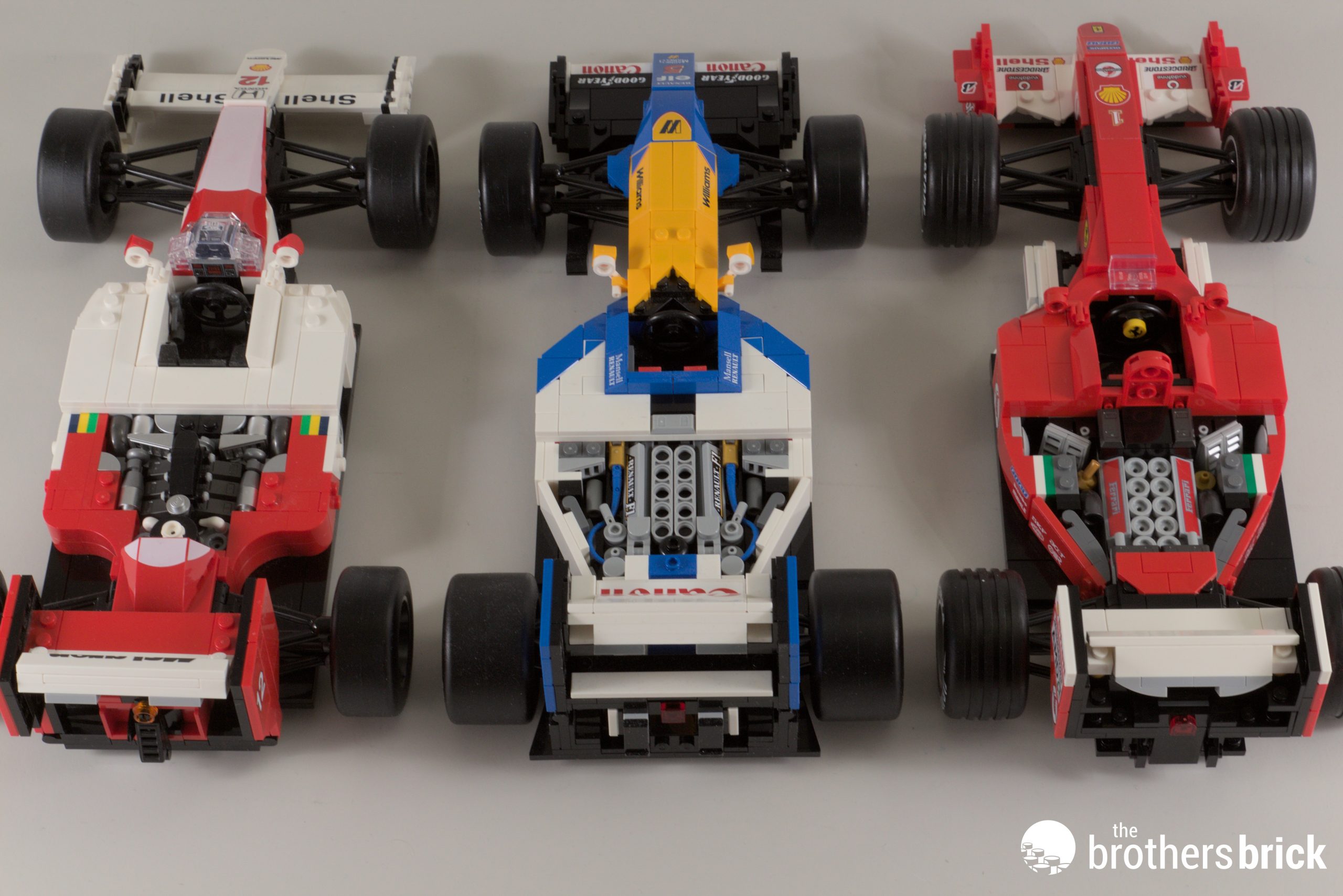
Taking the engine covers off illustrates my earlier point about the Ferrari’s engine bay feeling a little empty. The McLaren’s Honda V6 and Williams’ Renault V10 are much more detailed.
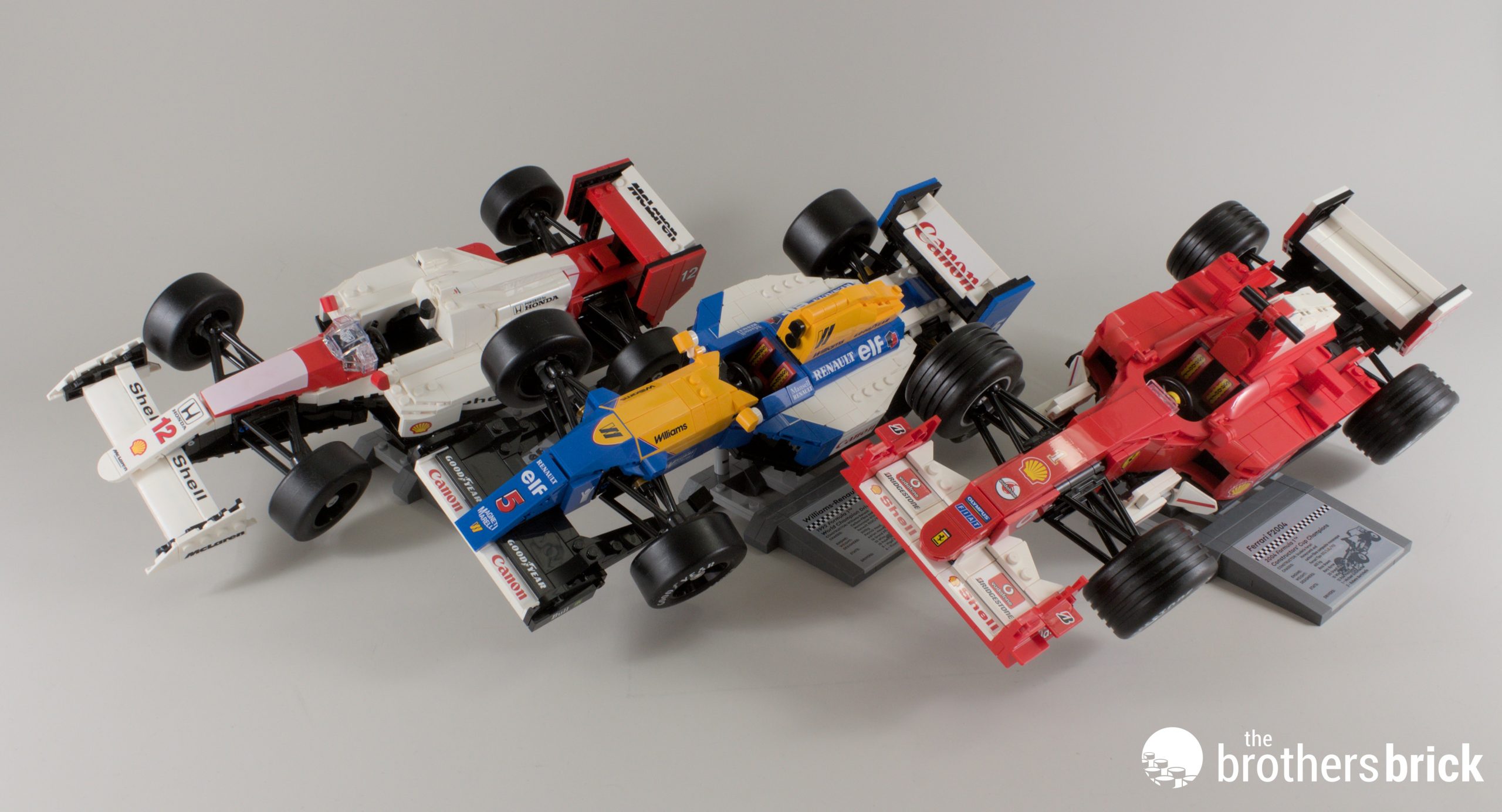
Still: engine covers on and mounted on stands, all three look really nice together.
Conclusion and recommendation
The previous two cars in what I’ll call the ‘Icons of F1’ line were fine efforts, but were still left wanting in some aspects. As they say: third time’s the charm, and even setting aside my personal bias, the Ferrari F2004 is comfortably the best one of the three. There’s plenty of detail inside and out, and those wheels are drop-dead gorgeous. Most importantly, the compromises that have to be made to transition to a LEGO set don’t detract from the car’s shaping. However, LEGO has raised the price from $80 to $90. The Williams is fundamentally the same: dual-moulded wheels, stickers rather than prints, and more pieces. So if those $10 make a difference to you, pick up the FW14B. If not, the F2004 is still the superior model.
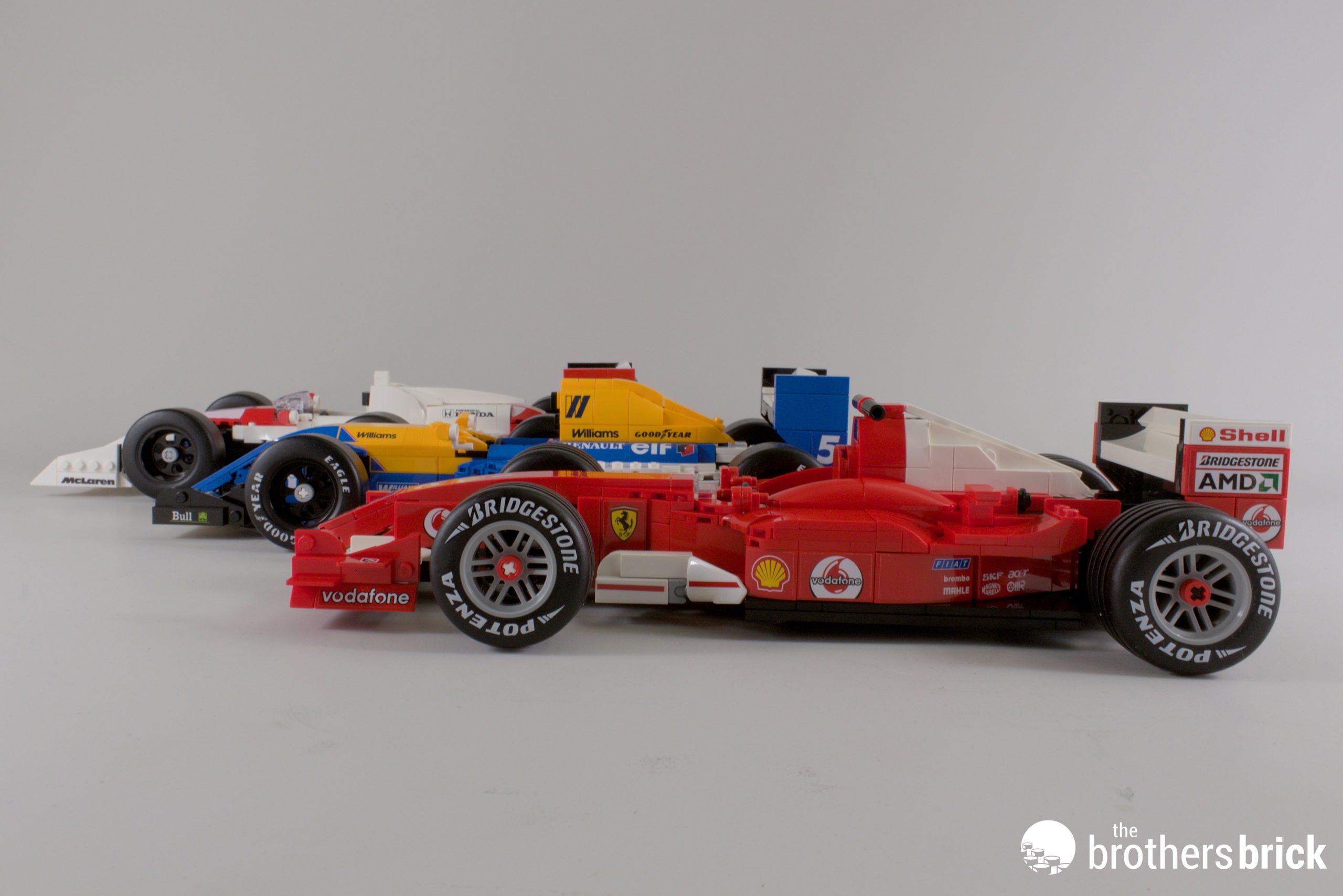
Other than a pointless price-hike, the only criticism I have is that this set doesn’t really do anything new. The construction is very similar to the MP4/4 and particularly the FW14B. Based on the release pattern, the next Icons of F1 set should be something from the 2010s, so it would most likely be one of Sebastian Vettel’s Red Bulls or a Lewis Hamilton Mercedes. However, I’d like to see something a bit different. After McLaren, Williams and Ferrari, the next most storied name in F1 history is surely Lotus, so perhaps the Lotus 49 (1967), 72 (1970) or 78 (1977) should be next. But as we know: reading patterns into LEGO’s release schedule is a fool’s errand.
LEGO Icons 11375 Ferrari F2004 & Michael Schumacher | 735 Pieces | Available March 1, 2026 | US $89.99 | CAN $119.99 | UK £79.99
The LEGO Group provided The Brothers Brick with an early copy of this set for review. Providing TBB with products for review guarantees neither coverage nor positive reviews.
Race through our full gallery of pictures: